MCQ
Minimum deviation is observed with a prism having angle of prism $A$, angle of deviation $\delta$, angle of incidence $i$ and angle of emergence e. We then have generally
  • A
    $i>e$
  • B
    $i<\mathrm{e}$
  • $i=e$
  • D
    $i=e=\delta$

Answer

Correct option: C.
$i=e$
In minimum deviation condition $\angle i=\angle e, \angle r_1=\angle r_2$

Need a full question paper?

Generate a complete, print-ready paper with questions like this in minutes — across 16+ boards, with answer keys.
Start Generating Free

Similar questions

The magnetic lines of force inside a bar magnet
A $50$ volt potential difference is suddenly applied to a coil with $L=5 \times 10^{-3}$ henry and $R=180 \mathrm{ohm}$. The rate of increase of current after $0.001$ second is
Work done in converting one gram of ice at $-10^{\circ} \mathrm{C}$ into steam at $100^{\circ} \mathrm{C}$ is
A closed hollow insulated cylinder is filled with gas at $0^{\circ} \mathrm{C}$ and also contains an insulated piston of negligible weight and negligible thickness at the middle point. The gas on one side of the piston is heated to $100^{\circ} \mathrm{C}$. If the piston moves $5 \mathrm{~cm}$, the length of the hollow cylinder is
The de-Broglie wavelength of a particle moving with a velocity 2.25 $\times 10 \mathrm{~m} / \mathrm{s}$ is equal to the wavelength of photon. The ratio of kinetic energy of the particle to the energy of the photon is (velocity of light is $3 \times 10 \mathrm{~m} / \mathrm{s}$ )
A body takes 4 minutes to cool from $100^{\circ} \mathrm{C}$ to $70^{\circ} \mathrm{C}$. To cool from $70^{\circ} \mathrm{C}$ to $40^{\circ} \mathrm{C}$ it will take (room temperature is $15^{\circ} \mathrm{C}$ )
A vessel of depth $2 \mathrm{~d} \mathrm{~cm}$ is half filled with a liquid of refractive index $\mu_1$ and the upper half with a liquid of refractive index $\mu_2$. The apparent depth of the vessel seen perpendicularly is
A ball is dropped on the floor from a height of $10 m$. lt rebounds to a height of $2.5 m$. If the ball is in contact with the floor for $0.01 sec$, the average acceleration during contact is
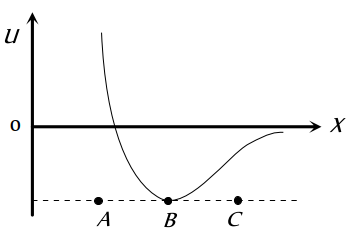
The potential energy $U$ between two molecules as a function of the distance $X$ between them has been shown in the figure. The two molecules are

Image

A particle is performing simple harmonic motion with amplitude $A$ and angular velocity $\omega$. The ratio of maximum velocity to maximum acceleration is