MCQ
Minimum excitation potential of Bohr's first orbit in hydrogen atom is.....$V$
  • A
    $13.6$
  • B
    $3.4 $
  • $10.2$
  • D
    $3.6$

Answer

Correct option: C.
$10.2$
c
(c) Excitation potential$ = \frac{{{\rm{Excitation \,\,energy}}}}{{\rm{e}}}$

Minimum excitation energy corresponds to excitation from $n = 1$ to $n = 2$

Minimum excitation energy in hydrogen atom $ = - 3.4 - ( - 13.6) = + 10.2\,eV$ 

so minimum excitation potential $= 10.2\, eV.$

Need a full question paper?

Generate a complete, print-ready paper with questions like this in minutes — across 16+ boards, with answer keys.
Start Generating Free

Similar questions

Hydrogen atom emits blue light when it changes from $n = 4$ energy level to the $n = 2$ level. Which colour of light would the atom emit when it changes from the $n = 5$ level to the $n = 2$ level
The momentum of a body is increased by $50 \%$. The percentage increase in the kinetic energy of the body is $...........\,\%$
A current of $3$ $amp$ is flowing in a plane circular coil of radius $4\, cm$ and number of turns $20$. The coil is placed in a uniform magnetic field of magnetic induction $0.5\, tesla$. Then, the dipole moment of the coil is.....$A-m^2$
The energy of electromagnetic wave in vacuum is given by the relation
If the kinetic energy of an electron is increased four times, the wavelength of the de-Broglie wave associated with it would become
A solid cylinder rolls down an inclined plane from a height $h$. At any moment the ratio of rotational kinetic energy to the total kinetic energy would be 
An ideal gas expands from volume $V_1$ to $V_2$. This may be achieved by either of the three processes: isobaric, isothermal and adiabatic. Let $\Delta U$ be the change in internal energy of the gas, $Q$ be the quantity of heat added to the system and $W$ be the work done by the system on the gas. Identify which of the following statements is false for $\Delta U$?
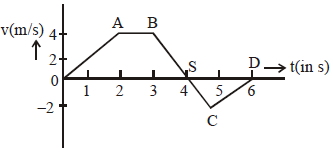
The velocity $(v)$ and time $(t)$ graph of a body in a straight line motion is shown in the figure. The point $S$ is at $4.333$ seconds. The total distance covered by the body in $6 \;s$ is$.......m$
Given below are two statements: one is labelled as Assertion $A$ and the other is labelled as Reason $R$

Assertion $A:$ The binding energy per nucleon is practically independent of the atomic number for nuclei of mass number in the range $30$ to $170$.

Reason $R$ : Nuclear force is short ranged.

In the light of the above statements, choose the correct answer from the options given below on

The solids which have the negative temperature coefficient of resistance are :