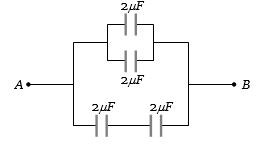
Minimum number of capacitors of $2\,\mu F$ capacitance each required to obtain a capacitor of $5\,\mu F$ will be
Medium


Download our appand get started for free
Experience the future of education. Simply download our apps or reach out to us for more information. Let's shape the future of learning together!No signup needed.*
Similar Questions
- 1Ten electrons are equally spaced and fixed around a circle of radius $R$. Relative to $V = 0$ at infinity, the electrostatic potential $V$ and the electric field $E$ at the centre $C$ areView Solution
- 2A uniform electric field having a magnitude ${E_0}$ and direction along the positive $X - $ axis exists. If the potential $V$ is zero at $x = 0$, then its value at $X = + x$ will beView Solution
- 3A capacitor of capacitance $C$ is charged to a potential difference $V$ from a cell and then disconnected from it. A charge $+Q$ is now given to its positive plate. The potential difference across the capacitor is now $Q$View Solution
if $V < CV$
- 4View SolutionA parallel plate air-core capacitor is connected across a source of constant potential difference. When a dielectric plate is introduced between the two plates then :
- 5The energy stored in the electric field produced by a metal sphere is $4.5\, J$. lf the sphere contains $4\,\mu C$ charge, its radius will be.......$mm$ : [Take : $\frac{1}{{4\pi {\varepsilon _0}}} = 9 \times {10^9}\,N - {m^2}\,/{C^2}\, ]$View Solution
- 6An air capacitor of capacity $C = 10\,\mu F$ is connected to a constant voltage battery of $12\,V$. Now the space between the plates is filled with a liquid of dielectric constant $5$. The charge that flows now from battery to the capacitor is......$\mu C$View Solution
- 7The two thin coaxial rings, each of radius $'a'$ and having charges $+{Q}$ and $-{Q}$ respectively are separated by a distance of $'s'.$ The potential difference between the centres of the two rings is :View Solution
- 8Point charge ${q_1} = 2\,\mu C$ and ${q_2} = - 1\,\mu C$ are kept at points $x = 0$ and $x = 6$ respectively. Electrical potential will be zero at pointsView Solution
- 9Electric potential at a point $P$ due to a point charge of $5 \times 10^{-9}\; C$ is $50 \;V$. The distance of $P$ from the point charge is ......... $cm$View Solution
(Assume, $\frac{1}{4 \pi \varepsilon_0}=9 \times 10^{+9}\; Nm ^2 C ^{-2}$)
- 10Two capacitors of capacitances $3\,\mu \,F$ and $6\,\mu F$ are charged to a potential of $12 \,V$ each. They are now connected to each other, with the positive plate of each joined to the negative plate of the other. The potential difference across each will be......$volt$View Solution