Electric potential at a point $P$ due to a point charge of $5 \times 10^{-9}\; C$ is $50 \;V$. The distance of $P$ from the point charge is ......... $cm$
(Assume, $\frac{1}{4 \pi \varepsilon_0}=9 \times 10^{+9}\; Nm ^2 C ^{-2}$)
JEE MAIN 2023, Easy
Download our app for free and get started
$V _{ P }=\frac{K Q}{ r }$
$50=\frac{9 \times 10^9 \times 5 \times 10^{-9}}{ r }$
$r =\frac{45}{50}=\frac{9}{10}=0.9\,m =90\,cm$

Download our appand get started for free
Experience the future of education. Simply download our apps or reach out to us for more information. Let's shape the future of learning together!No signup needed.*
Similar Questions
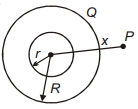
- 1Two concentric hollow conducting spheres of radius $r$ and $R$ are shown. The charge on outer shell is $Q$. What charge should be given to inner sphere so that the potential at any point $P$ outside the outer sphere is zero?View Solution
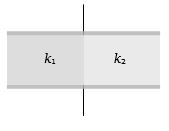
- 2A parallel plate condenser is filled with two dielectrics as shown. Area of each plate is $A\;metr{e^2}$ and the separation is $t$ $metre$. The dielectric constants are ${k_1}$ and ${k_2}$ respectively. Its capacitance in farad will beView Solution
- 3The electric potential at any point as a function of distance $(x)$ in meter is given by $V = 5x^2 + 10x -9 \,(volt)$ Value of electric field at $x = 1$ is......$Vm^{-1}$View Solution
- 4An $\alpha$ particle and a proton are accelerated from rest through the same potential difference. The ratio of linear momenta acquired by above two particals will be.View Solution
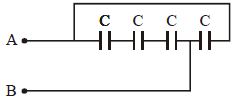
- 5The equivalent capacitance between $A$ and $B$ isView Solution
- 6Minimum number of capacitors of $2\,\mu F$ capacitance each required to obtain a capacitor of $5\,\mu F$ will beView Solution
- 7A capacitor of capacitance $1$ $\mu F$ withstands the maximum voltage $6$ $kV$ while a capacitor of $2$ $\mu F$ withstands the maximum voltage $4$ $kV$. What maximum voltage will the system of these two capacitor withstands if they are connected in series?......$kV$View Solution
- 8Dipole having dipole moment $4\,C-m$ is placed on origin along $x-$ axis. Point charge of $8\,\mu C$ is fixed at $(4, 0, 0)$ . Now dipole is rotated by an angle of $\frac{\pi }{2}$ . Find the work done (in $mJ$ ) in rotating the dipole.......$mJ$View Solution
- 9Three concentric spherical shells have radii $a, b$ and $c (a < b < c)$ and have surface charge densities $\sigma ,-\;\sigma $ and $\;\sigma \;$ respectively. If $V_A,V_B$ and $V_C$ denote the potentials of the three shells, then, for $c = a +b,$ we haveView Solution
- 10A point electric dipole placed at the origin has a potential given by $V(r, \theta)=\frac{p \cos \theta}{4 \pi \varepsilon_0 r^2}$, where $\theta$ is the angle made by the position vector with the direction of the dipole. Then,View Solution