Question
'Mirage' is a phenomenon due to

Answer

(c) Mirage is a phenomenon observed due to the total internal reflection of light when light travels from a denser medium to a rarer medium. When the angle of incidence of light is more than the critical angle for the two adjacent media, the light gets totally internally reflected.

Need a full question paper?

Generate a complete, print-ready paper with questions like this in minutes — across 16+ boards, with answer keys.
Start Generating Free

Similar questions

Two wires $A$ and $B$ of same material have radii in the ratio $2: 1$ and lengths in the ratio $4: 1$. The ratio of the normal forces required to produce the same change in the lengths of these two wires is .......
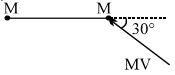
Two equal masses each of mass $M$ are joined by a massless rod of length $L$. Now an impulse $MV$ is given to the mass $M$ making an angle of $30^o$ with the length of the rod. The angular veloctiy of the rod just after imparting the impulse is
The coefficient of linear expansion of crystal in one direction is ${\alpha _1}$ and that in every direction perpendicular to it is ${\alpha _2}$. The coefficient of cubical expansion is
A gas undergoes a change of state during which $100 J$ of heat is supplied to it and it does $20 J$ of work. The system is brought back to its original state through a process during which $20 J$ of heat is released by the gas. The work done by the gas in the second process is ....... $J$
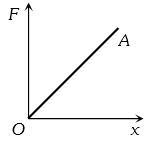
The force required to stretch a spring varies with the distance as shown in the figure. If the experiment is performed with the above spring of half length, the line $OA$ will
An arrow is shot into air. Its range is $200\,m$ and its time of flight is $5\,s$. If $g=10\,m / s ^2$, then horizontal component of velocity and the maximum height will be respectively
Two capacitors of equal capacity are first connected in parallel and then in series. The ratio of the total capacities in the two cases will be
Assume that protons and neutrons have equal masses. Mass of a nucleon is $1.6 \times 10^{-27}\,kg$ and radius of nucleus is $1.5 \times 10^{-15} A ^{1 / 3}\,m$. The approximate ratio of the nuclear density and water density is $n \times 10^{13}$. The value of $n$ is $.................$
A ring of radius $R$, made of an insulating material carries a charge $Q$ uniformly distributed on it. If the ring rotates about the axis passing through its centre and normal to plane of the ring with constant angular speed $\omega $, then the magnitude of the magnetic moment of the ring is
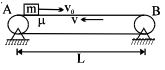
With what minimum velocity should block be projected from left end $A$ towards end $B$ such that it reaches the other end $B$ of conveyer belt moving with constant velocity $v$. Friction coefficient between block and belt is $\mu$ .