Question
Modern treatment method $P.E.T.$ is based on $!$

Answer

$P.E.T.$ is positron emission tomography is a nuclear medicine functional imaging technique used to observe metabolic processes to diagnosis of disease.

$F ^{18} \rightarrow$ positron $+ r$ rays, used to detect cancer heart prob. brain dis$-$order

Need a full question paper?

Generate a complete, print-ready paper with questions like this in minutes — across 16+ boards, with answer keys.
Start Generating Free

Similar questions

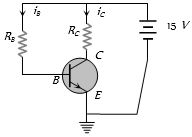
In the following common emitter circuit if $\beta = 100, V_{CE} = 7V, V_{BE} =$ Negligible $R_C = 2 k \Omega$ then $I_B = ?$....$mA$
Assertion: A double convex lens $(\mu = 1.5)$ has focal length $10\,cm$. When the lens is immersed in water $(\mu = 4/3)$ its focal length becomes $40\,cm$

Reason: $\frac{1}{f} = \frac{{{\mu _1} - {\mu _m}}}{{{\mu _m}}} \left( {\frac{1}{{{R_1}}} - \frac{1}{{{R_2}}}} \right)$
In a $YDSE$ bi-chromatic light of wavelengths $400\, nm$ and $560 \,nm$ are used. The distance between the slits is $0.1 \,mm$ and the distance between the plane of the slits and the screen is 1m. The minimum distance between two successive regions of complete darkness is......$mm$
Inside a hollow charged spherical conductor, the potential
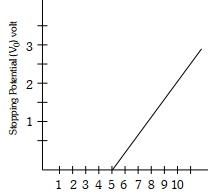
The variation of stopping potential $\left(V_0\right)$ as a function of the frequency $(\nu)$ of the incident light for a metal is shown in figure. The work function of the surface is $...........\,eV$
In an astronomical telescope, the focal length of the objective lens is $100 \,cm$ and of eye-piece is $2 \,cm.$ The magnifying power of the telescope for the normal eye is
A spring with spring constant $k $  is extended from $x = 0$to$x = {x_1}$. The work done will be
A pendulum suspended from the ceiling of a train oscillates with a time period $2$ $second$ , when the train is accelerating at $10\,ms^{-2}$. What will be its time period when the train retards at $10\,ms^{-2}$ ? .... $s$
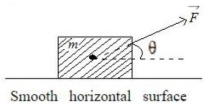
An object of mass ' $m$ ' initially at rest on a smooth horizontal plane starts moving under the action of force $F=2 N$. In the process of its linear motion, the angle $\theta$ (as shown in figure) between the direction of force and horizontal varies as $\theta= kx$, where $k$ is a constant and $x$ is the distance covered by the object from its initial position. The expression of kinetic energy of the object will be $E =\frac{ n }{ k } \sin \theta$. The value of $n$ is $.....$
A satellite of mass $m$ revolves around the earth of radius $R$ at a height $x$ from its surface. If $g$ is the acceleration due to gravity on the surface of the earth, the orbital speed of the satellite is