Question
Modulus of rigidity of diamond is

Answer

(b)

Need a full question paper?

Generate a complete, print-ready paper with questions like this in minutes — across 16+ boards, with answer keys.

Start Generating Free

Similar questions

$A$ thin prism of angle $5^o$ is placed at a distance of $10\,cm$ from object. What is the distance of the image from object? (Given $\mu$ of prism $= 1.5$)
If a current I given by ${I_0}\sin \,\left( {\omega \,t - \frac{\pi }{2}} \right)$ flows in an $ ac $ circuit across which an ac potential of $E = {E_0}\sin \omega \,t$ has been applied, then the power consumption P in the circuit will be
The escape velocity from earth is ${v_{es}}.$ A body is projected with velocity $2{v_{es}}$ with what constant velocity will it move in the inter planetary space
$Assertion$ : A body with constant acceleration always moves along a straight line.

$Reason$ : A body with constant acceleration may not speed up.
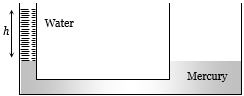
Two communicating vessels contain mercury. The diameter of one vessel is $n$ times larger than the diameter of the other. A column of water of height $ h$  is poured into the left vessel. The mercury level will rise in the right-hand vessel ($s =$ relative density of mercury and $\rho  = $ density of water) by
Two point masses $m$ and $M$ are separated by a distance $L$. The distance of the centre of mass of the system from m is
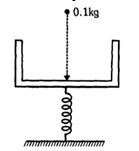
A massless platform is kept on a light elastic spring as shown in fig. When a sand particle of mass $0.1\; kg$ is dropped on the pan from a height of $0.24 \;m$, the particle strikes the pan and spring is compressed by $0.01\; m$.

From what height should the particle be dropped to cause a compression of $0.04\; m$.
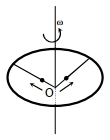
A ring of mass $M$ and radius $R$ is rotating with angular speed $\omega$ about a fixed vertical axis passing through its centre $O$ with two point masses each of mass $\frac{ M }{8}$ at rest at $O$. These masses can move radially outwards along two massless rods fixed on the ring as shown in the figure. At some instant the angular speed of the system is $\frac{8}{9} \omega$ and one of the masses is at a distance of $\frac{3}{5} R$ from $O$. At this instant the distance of the other mass from $O$ is
Two waves are simultaneously passing through a string and their equations are :

${y}_{1}={A}_{1} \sin {k}({x}-v {t}), {y}_{2}={A}_{2} \sin {k}\left({x}-{vt}+{x}_{0}\right) .$ Given amplitudes ${A}_{1}=12\, {mm}$ and ${A}_{2}=5\, {mm}$ ${x}_{0}=3.5\, {cm}$ and wave number ${k}=6.28\, {cm}^{-1}$. The amplitude of resulting wave will be $......\,{mm}$
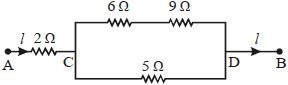
In the circuit shown in figure, the $5\,\Omega $ resistance develops $20.00\,cal/s$ due to the current flowing through it. The heat developed in $2\,\Omega $ resistance (in $cal/s$ ) is