MCQ
Molar concentration $(M)$ of any solution $=$
  • $\frac{{{\rm{No}}\,{\rm{. of \,moles\, of\, solute}}}}{{{\rm{Volume\, of \,solution\, in\, litre}}}}$
  • B
    $\frac{{{\rm{No}}{\rm{. \,of \,gram\, equivalent \,of \,solute}}}}{{{\rm{Volume \,of \,solution\, in \,litre}}}}$
  • C
    $\frac{{{\rm{No}}{\rm{. \,of \,moles\, of\, solute}}}}{{{\rm{Mass \,of \,solvent \,in\, kg}}}}$
  • D
    $\frac{{{\rm{No}}{\rm{. \,of\, moles \,of \,any \,constituent}}}}{{{\rm{Total\, no}}{\rm{.\, of \,moles \,of \,all \,constituents}}}}$
Answer

Correct option: A.
$\frac{{{\rm{No}}\,{\rm{. of \,moles\, of\, solute}}}}{{{\rm{Volume\, of \,solution\, in\, litre}}}}$
a
Molarity $(M)$ is defined as the number of moles of solute per liter of solution.

$\text { molarity }=\frac{\text { moles of solute }}{\text { volume of solution in litre. }}$

Need a full question paper?

Generate a complete, print-ready paper with questions like this in minutes — across 16+ boards, with answer keys.

Start Generating Free

Similar questions

Which one of the following is non-ideal solution
The rate constant for a reaction can be increased by $\underline{a}$ the stability of the reactant or by $\underline{b}$ the stability of the transition state. Select the correct choice for $a$ and $b$
Match the catalysts to the correct processes : 

Catalyst  Process 
$(A)$  $TiCl_4$ $(i)$  Wacker process
$(B)$  $PdCl_2$ $(ii)$  Ziegler - Natta polymerization
$(C)$  $CuCl_2$ $(iii)$  Contact process
$(D)$  $V_2O_5$ $(iv)$  Deacon's process


$\begin{array}{*{20}{c}}
  {O\,\,\,\,\,\,\,\,\,\,\,\,\,\,\,\,\,\,\,\,\,\,\,\,\,\,\,\,\,\,\,\,\,\,\,\,\,\,\,\,\,\,\,\,\,\,\,\,\,\,\,\,\,\,\,\,\,\,\,\,\,O} \\ 
  {||\,\,\,\,\,\,\,\,\,\,\,\,\,\,\,\,\,\,\,\,\,\,\,\,\,\,\,\,\,\,\,\,\,\,\,\,\,\,\,\,\,\,\,\,\,\,\,\,\,\,\,\,\,\,\,\,\,\,\,\,\,\,||} \\ 
  {H - C - C{H_2}C{H_2}C{H_2}C{H_2} - C - H} 
\end{array}$ $\xrightarrow{{O\mathop {H/\Delta }\limits^{\Theta \,\,\,} }}$ Product $(A)$ is
The specific conductance of a $0.1\, N\, KCl$ solution at $23\,^oC$ is $0.012\, \,ohm^{-1}\,cm^{-1}$. The resistance of cell containing the solution at the same temperature was found to be $55\, ohm$. The cell constant will be ............. $\mathrm{cm}^{-1}$
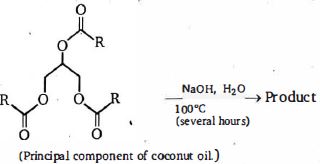
Product is obtained in the above reaction is
A constant current was passed through a solution of $\mathrm{AuCl}_4^{-}$ion between gold electrodes. After a period of $10.0$ minutes, the increase in mass of cathode was $1.314 \mathrm{~g}$. The total charge passed through the solution is___________ $\times 10^{-2} \mathrm{~F}$.(Given atomic mass of $\overline{\mathrm{Au}}=\overline{197}$ )
Hexa ammine nickel $(II)$ hexa nitro cobaltate $(III)$ can be written as:
Which of the following acids forms three series of salts ?
The molar freezing point constant for water is ${1.86\,^o}C\,mol{e^{ - 1}}$. If $ 342\,gm$ of canesugar $({C_{12}}{H_{22}}{O_{11}})$ are dissolved in $1000\,gm$ of water, the solution will freeze at ............ $^oC$.