MCQ
Moseley's Law for characteristic $X-$ray is $\sqrt{\text{v}}=\text{a}(\text{z}-\text{b})$. Here,
  • Both $a$ and $b$ are independent of the material.
  • B
    $a$ is independent but $b$ depends on the material.
  • C
    $b$ is independent but a depends on the material.
  • D
    Both $a$ and $b$ depend on the material.
Answer

Correct option: A.
Both $a$ and $b$ are independent of the material.
Moseley's Law for characteristic $X-$ray is $\sqrt{\text{v}}=\text{a}(\text{z}-\text{b})$where, a and b are constants independent of the material used.

Need a full question paper?

Generate a complete, print-ready paper with questions like this in minutes — across 16+ boards, with answer keys.

Start Generating Free

Similar questions

Maxwell in his famous equations of electromagnetism introduced the concept of:
In Young's double slit interference experiment, the slit separation is made 3 fold. The fringe width becomes
$V$ (stopping potential) is plotted against $\frac{1}{\lambda}$, where $\lambda$ is wavelength of incident radiations, for two metals
A $N-$ type semiconductor is
Two spheres $A$ and $B$ of radius $4\,cm$ and $6\,cm$ are given charges of $80\,\mu c$ and $40\,\mu c$ respectively. If they are connected by a fine wire, the amount of charge flowing from one to the other is
If a convex lens of focal length 80 cm and a concave lens of focal length 50 cm are combined together, what will be their resulting power
The radioactive nucleus $_7{N^{13}}$decays to $_6{C^{13}}$ through the emission of
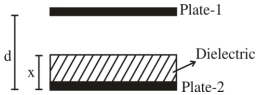
A parallel plate capacitor with plate area $A$ and plate separation $d$ is filled with a dielectric material of dielectric constant $K =4$. The thickness of the dielectric material is $x$, where $x < d$.

Let $C_1$ and $C_2$ be the capacitance of the system for $x =\frac{1}{3} d$ and $x =\frac{2 d }{3}$, respectively. If $C _1=2 \mu F$ the value of $C _2$ is $........... \mu F$

If $n$ drops, each of capacitance $C,$ coalesce to form a single big drop, then the ratio of the energy stored in the big drop to that in each small drop will be
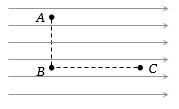
Figure shows three points $A$, $B$ and $C$ in a region of uniform electric field $\overrightarrow E $. The line $AB$ is perpendicular and $BC$ is parallel to the field lines. Then which of the following holds good. Where ${V_A} > {V_B}$ and ${V_C}$ represent the electric potential at points $A$, $B$ and $C$ respectively