MCQ
Most acidic among given compound is
- A$Pr(OH)_3$
- B$Gd(OH)_3$
- C$Sm(OH)_3$
- ✓$Er(OH)_3$
Generate a complete, print-ready paper with questions like this in minutes — across 16+ boards, with answer keys.
$(I)\, SP_4 \,\,\,(II)\, XeO_4 \,\,\,(Ill) \,XeF_4 \,\,\,(IV)\, ICl^-_4$
Product $(P)$ will be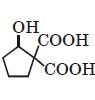
$E_{{A^{3 + }}/A}^o = 1.50\,\,V\,,$ $E_{{B^{2 + }}/B}^o = 0.3\,\,V,$
$E_{{C^{3 + }}/C}^o = - \,0.74\,\,V,$ $E_{{D^{2 + }}/D}^o = - \,2.37\,\,V.$
The correct sequence in which the various metals are deposited at the cathode is

$6 \mathrm{OH}^{-}+\mathrm{Cl}^{-} \rightarrow \mathrm{ClO}_{3}^{-}+3 \mathrm{H}_{2} \mathrm{O}+6 \mathrm{e}^{-}$
A current of $x A$ has to be passed for $10 h$ to produce $10.0 \mathrm{~g}$ of potassium chlorate. The value of $\mathrm{x}$ is $.......$ (Nearest integer)
(Molar mass of $\left.\mathrm{KClO}_{3}=122.6 \mathrm{~g} \mathrm{~mol}^{-1}, \mathrm{~F}=96500 \mathrm{C}\right)$
$'A'$ on reaction with sodium hypoiodite gives $'B',$ which on further heating with soda lime gives ' $C$ '. The compound ' $C$ ' is $....... .$
$C{O_2}(s) \rightleftharpoons C{O_2}(g)$