MCQ
Motion of a moving electron is not affected by
  • A
    An electric field applied in the direction of motion
  • Magnetic field applied in the direction of motion
  • C
    Electric field applied perpendicular to the direction of motion
  • D
    Magnetic field applied perpendicular to the direction of motion
Answer

Correct option: B.
Magnetic field applied in the direction of motion
b
(b) When field is parallel to the direction of motion of charge, magnetic force on it is zero.

Need a full question paper?

Generate a complete, print-ready paper with questions like this in minutes — across 16+ boards, with answer keys.

Start Generating Free

Similar questions

Two light bulbs in the circuit have rating $A\,[24\ V, 48\,W]$ and $B\,[24\ V, 36\,W]$ as shown.
A student attempts to pull himself up by tugging on his hair. He will not succeed
A plano convex lens $(f = 20cm)$ is silvered at plane surface. Now $f$ will be........$cm$
If the kinetic energy of a body increases by $0.1\%$, the percent increase of its momentum will be .............. $\%$
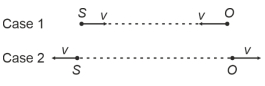
A source $(S)$ of sound has frequency $240 \ Hz$. When the observer $(O)$ and the source move towards each other at a speed $v$ with respect to the ground (as shown in Case $1$ in the figure), the observer measures the frequency of the sound to be $288 \ Hz$. However, when the observer and the source move away from each other at the same speed $v$ with respect to the ground (as shown in Case $2$ in the figure), the observer measures the frequency of sound to be $n Hz$. The value of $n$ is. . . . . .
When white light enters a prism, it gets split into its constituent colours. This is due to
A given mass of a gas is allowed to expand freely until its volume becomes double. If ${C_b}$ and ${C_a}$ are the velocities of sound in this gas before and after expansion respectively, then ${C_a}$ is equal to
A small object is placed at a distance of $4 \,m$ from the objective of a telescope of focal length $2 \,m$. The focal length of the eyepiece is $0.2 m$. The final image of the object
A uniform disc with mass $M=4\,kg$ and radius $R=$ $10\,cm$ is mounted on a fixed horizontal axle as shown in figure. A block with mass $m =2\,kg$ hangs from a massless cord that is wrapped around the rim of the disc. During the fall of the block, the cord does not slip and there is no friction at the axle. The tension in the cord is_______ $N$

$\left(\right.$ Take $\left.g =10\,ms ^{-2}\right)$

A particle of mass $m$ oscillates with simple harmonic motion between points ${x_1}$ and ${x_2}$, the equilibrium position being $O$. Its potential energy is plotted. It will be as given below in the graph