MCQ
Motion of a moving electron is not affected by
  • A
    An electric field applied in the direction of motion
  • Magnetic field applied in the direction of motion
  • C
    Electric field applied perpendicular to the direction of motion
  • D
    Magnetic field applied perpendicular to the direction of motion
Answer

Correct option: B.
Magnetic field applied in the direction of motion
b
(b) When field is parallel to the direction of motion of charge, magnetic force on it is zero.

Need a full question paper?

Generate a complete, print-ready paper with questions like this in minutes — across 16+ boards, with answer keys.

Start Generating Free

Similar questions

The wave nature of electrons was experimentally verified by,
Two tangent galvanometers having coils of the same radius are connected in series. A current flowing in them produces deflections of $60° $ and $45°$  respectively. The ratio of the number of turns in the coils is
A dielectric slab of thickness $d$ is inserted in a parallel plate capacitor whose negative plate is at $x = 0$ and positive plate is at $x = 3d$. The slab is equidistant from the plates. The capacitor is given some charge. As one goes from $0$ to $3d$
The angle of dip at a place on the earth gives
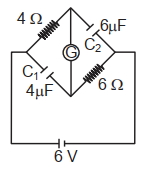
A galvanometer $(G)$ $\Omega$ of 2 risistance is connected in the givn circuit the raito of charge in $C_1$ and $C_2$ is:


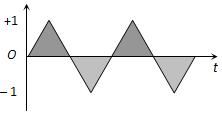
An alternating current of frequency 200 rad/sec and peak value 1A as shown in the figure, is applied to the primary of a transformer. If the coefficient of mutual induction between the primary and the secondary is 1.5 H, the voltage induced in the secondary will be
The electron in a hydrogen atom makes a transition $n_1\, \rightarrow \,n_2$ whose $n_1$ and $n_2$ are the principal quantum numbers of the two states. Assume the Bohr model to be valid. The frequency of orbital motion of the electron in the initial state is $1/27$ of that in the final state. The possible values of $n_1$ and $n_2$ are
Who evaluated the mass of electron indirectly with help of charge
In a Young’s double slit experiment, 12 fringes are observed to be formed in a certain segment of the screen when light of wavelength 600 nm is used. If the wavelength of light is changed to 400 nm, number of fringes observed in the same segment of the screen is given by
The electric potential $V$ at any point $(x, y, z),$ all in metres in space is given by $V = 4x^2$ volt. The electric field at the point $(1, 0, 2)$ in volt/meter, is