MCQ
$\mu = \sqrt{15}$ is true for the pair :-
- ✓$Co^{+2}, Cr^{+3}$
- B$Fe^{+2}, Cr^{+3}$
- C$Fe^{+3}, Fe^{+2}$
- D$Mn^{+2} , Fe^{+2}$
Hence there are three unpaired electrons in $\mathrm{Co}^{2+}$ Now the elctronic configuration of $\mathrm{Cr}^{3+}$ is; $[\mathrm{Ar}] 3 \mathrm{d}^{3}$
Hence there are 3 unpaired electrons in $\mathrm{Cr}^{3+}$ We know magnetic moment $\mu=\sqrt{(\mathrm{n}(\mathrm{n}+2)} \$ \$$
where n is number of unpaired electrons.
So when $n=3$ $\mu=\sqrt{(3(3+2)}=\sqrt{15}$
Hence option A is correct answer.
Generate a complete, print-ready paper with questions like this in minutes — across 16+ boards, with answer keys.
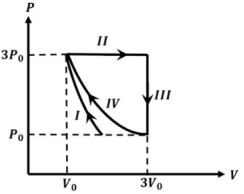
| List-$I$ | List-$II$ |
| $P$ In process $I$ | $1$ Work done by the gas is zero |
| $Q$ In process $II$ | $2$ Temperature of the gas remains unchanged |
| $R$ In process $III$ | $3$ No heat is exchanged between the gas and its surroundings |
| $S$ In process $IV$ | $4$ Work done by the gas is $6 P _0 V _0$ |