Question
Multiply and then evaluate :
$(4x + y)$ and $(x – 2y);$ when $x = 2$ and $y = 1.$

Answer

$(4x + y) \times (x − 2y)$
$= 4x (x − 2y) + y (x − 2y)$
$= 4x^2− 8xy + xy − 2y^2$
$= 4x^2 − 7xy − 2y^2$
Verification:
When $x = 2, y = 1$
$\text{L.H.S.} = (4x + y) (x − 2y)$
$= (4 \times 2 + 1) (2 − 2 \times 1)$
$= (8 + 1) (2 − 2)$
$= 9 \times 0$
$= 0$
$\text{R.H.S.} = 4x^2 − 7xy − 2y^2$
$= 4 (2)^2− 7 \times 2 \times 1 − 2 (1)^2$
$= 4 \times 4 − 14 − 2$
$= 16 − 16$
$= 0$
$\therefore \text{L.H.S.} = \text{R.H.S.}$

Need a full question paper?

Generate a complete, print-ready paper with questions like this in minutes — across 16+ boards, with answer keys.
Start Generating Free

Similar questions

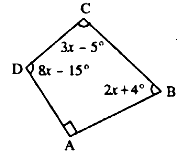
Use the information given in the following figure to find :
(i) x
(ii) ∠B and ∠C
Construct a triangle ABC given BC = 5 cm, AC = 6 cm and ∠C = 75°. Draw the bisector of the interior angle at A. Let this bisector meet BC at P ; measure BP
Multiply and then evaluate:
$(x^2 – y)$ and $(xy – y^2);$ when $x = 1$ and $y = 2.$
Using ruler and a pair compass only, construct a triangle PQR, given PQ = 5.5 cm, QR = 7.5 cm and RP = 6 cm. Draw the bisectors of the interior angles at P, Q and R. Do these bisectors meet at the same point ?
Construct a triangle ABC, in which AB = BC = 4 cm and ∠ABC = 60°. Draw all its lines of symmetry.
A girl got $375$ marks out of $500$ in the first term examination, $560$ marks out of $800$ in the second term examination, and $840$ marks out of $1200$ in the third term examination. Find:
(i) her percentage score in the first term examination.
(ii) her percentage score in the second term examination.
(iii) her percentage score in the third term examination.
(iv) the total marks secured in all the three examinations.
(v) the total marks scored in all the three examinations.
(vi) her percentage score on the whole in all three examinations.
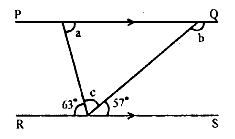
In the following figures, PQ is parallel to RS. Find the angles a, b and c:
Construct the 60° angle, using ruler and a pair of compass only.
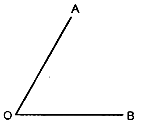
In your note-book copy the following angle using ruler and a pair compass only.
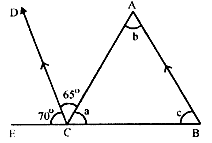
In the following figure, BA is parallel to CD. Find the angles a, b and c: