Question
Mutations are beneficial for plant breeding. Taking an example, justify the statement.

Answer

Mutation is the process by which genetic variations are created through changes, in the base sequence within genes resulting in the creation of a new character or trait not found in the parental type. It is possible to induce mutations artificially through use of chemicals or radiations (like gamma radiations), and selecting and using the plants that have the desirable character as a source in breeding. This process is called mutation breeding. In mung bean, resistance to yellow mosaic virus and powdery mildew were induced by mutations.

Need a full question paper?

Generate a complete, print-ready paper with questions like this in minutes — across 16+ boards, with answer keys.

Start Generating Free

Similar questions

Rahul introduced Ronit to his uncle and told him that Ronit is pursuing a course in biotechnology in America.
His uncle had never heard of this term earlier and was curious to know about this term. Ronit pointed towards a big tree at the base of which were present numerous tumour-like structures and said that this is the example of natural biotechnology:
  1. What is biotechnology?
  2. How these crown gall tumours are formed?
  3. What are the values shown by Rahul's uncle?
Explain the following two components of Darwin's theory of natural selection.
  1. Variations.
  2. Formation of new species.
  1. Explain the significance of 'palindromic nucleotide sequence' in the formation of recombinant DNA.
  2. Write the use of restriction endonuclease in the above process.
Classify the following as examples of homology and analogy:
  1. Mouth parts of cockroach and butterfly.
  2. Hearts of rabbits and human beings.
  3. Eyes of octopus and mammals.
  4. Sweet potato and potato.
  5. Stings of honeybee and scorpion.
  6. Tendrils of Lathyrus and tendrils of Gloriosa.
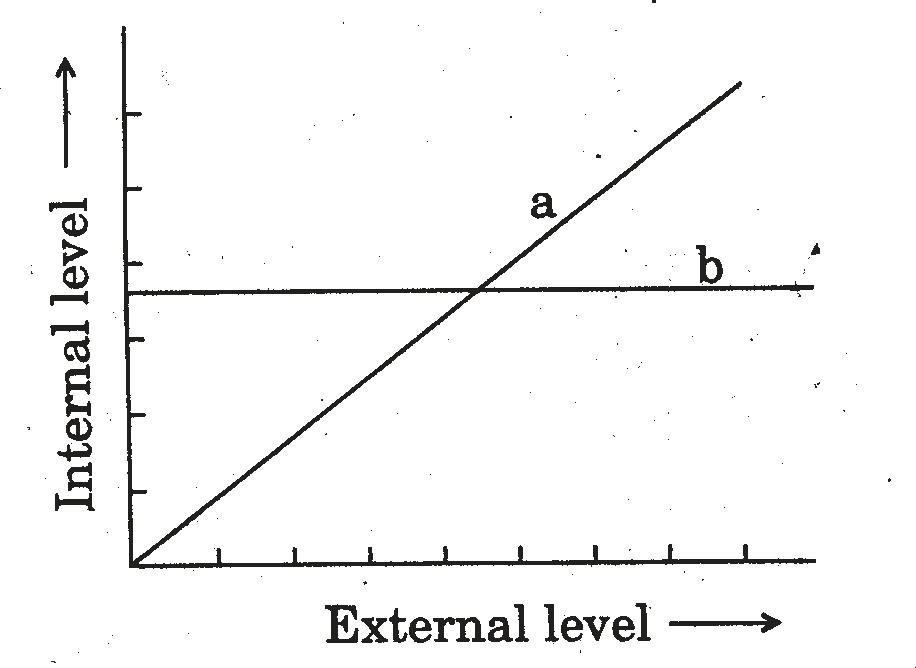
The following graph represents the organismic response to certain environmental condition (e.g., temperature):
  1. Which one of these, ‘a’ or ‘b’, depicts conformers?
  2. What does the other line graph depict?
  3. How do these organisms differ from each other with reference to homoeostasis?
  4. Mention the category to which humans belong.
Within what age group sexually transmitted diseases (STDs) are reported to be very high. Mention three practices to avoid them.
Answer the following questions:
How would the following affect the phenomenon of independent assortment?
  1. Crossing over.
  2. Linkage.
Define homologous organs. Give one example of an organ homologous to the hand of man.
Answer the following questions:
Explain female heterogamety with the help of an example.

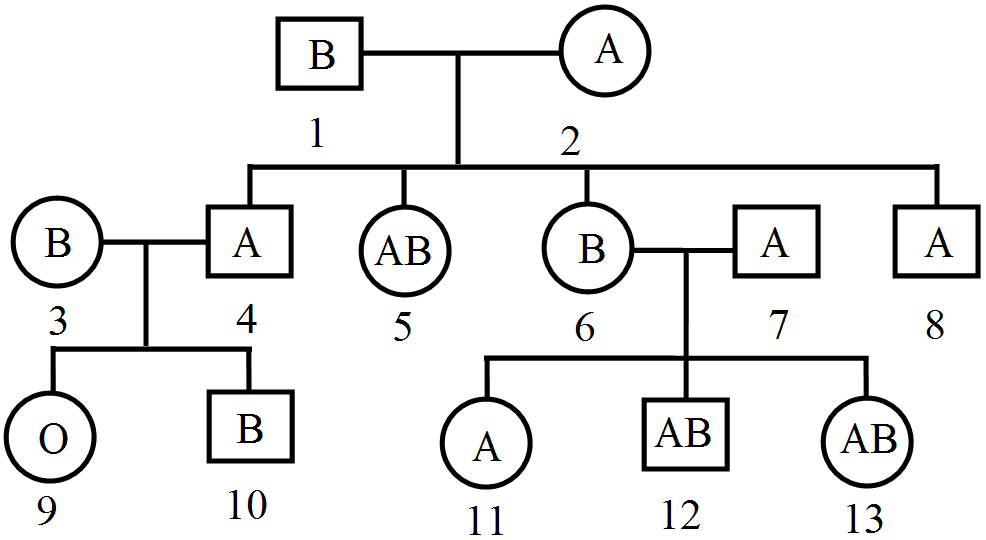
Study the pedigree chart given above, showing the inheritance pattern of blood groups in a family and answer the following questions:
  1. Give the possible genotypes of the individuals 1 and 2.
  2. Which antigen or antigens will be present on the plasma membranes of the RBCs of individuals 5 and 9?
  3. Give the genotypes of the individuals 3 and 4.