MCQ
Mutual inductance of two coils can be increased by
  • A
    Decreasing the number of turns in the coils
  • Increasing the number of turns in the coils
  • C
    Winding the coils on wooden core
  • D
    None of the above

Answer

Correct option: B.
Increasing the number of turns in the coils
b
(b) Mutual inductance of coils,

$M=\frac{\mu_{0} \mu_{r} N_{1} N_{2} A}{l}$

It is clear that mutual inductance or coils can be increased by increasing the number of turns in the coils

Need a full question paper?

Generate a complete, print-ready paper with questions like this in minutes — across 16+ boards, with answer keys.
Start Generating Free

Similar questions

An astronomical telescope has a magnifying power $10.$ The focal length of eyepiece is $20 \,cm$. The focal length of objective is.....$cm$
Assertion : A spark occur between the poles of a switch when the switch is opened.
Reason : Current flowing in the conductor produces magnetic field.
Out of the following statements which is not correct
Which of the following statement is true
A source emits light of wavelength $4700Å, 5400 Å$ and $6500 Å.$ The light passes through red glass before being tested by a spectrometer. Which wavelength is seen in the spectrum.....$\mathop A\limits^o $
A point object is placed at a distance of 10 cm and its real image is formed at a distance of 20 cm from a concave mirror. If the object is moved by 0.1 cm towards the mirror, the image will shift by about
Carbon -14 decays with half-life of about 5,800 years. In a sample of bone, the ratio of carbon -14 to carbon -12 is found to be $\frac {1}{4}$ of what it is in free air. This bone may belong to a period about x centuries ago, where x is nearest to
A wire of $1 \,\Omega$ has a length of $1\, m$. It is stetched till its length increases by $25\, \%$. The percentage change in resistance to the neartest integer is .....$\%$
When a proton is accelerated through 1V, then its kinetic energy will be
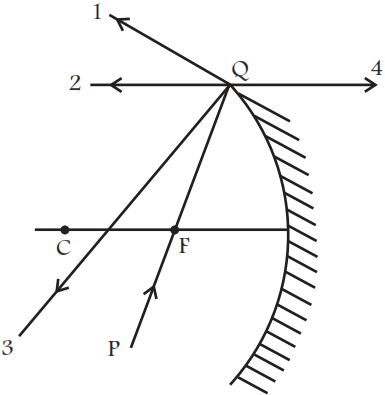
The direction of ray of light incident on a concave mirror is shown by $PQ$ while directions in which the ray would travel after reflection is shown by four rays marked $1, 2, 3$ and $4 (Fig)$. Which of the four rays correctly shows the direction of reflected ray?