MCQ
Myopia is due to
  • Elongation of eye ball
  • B
    Irregular change in focal length
  • C
    Shortening of eye ball
  • D
    Older age

Answer

Correct option: A.
Elongation of eye ball
a
(a) In myopia, eye ball may be elongated so, light rays focussed before the retina.

Need a full question paper?

Generate a complete, print-ready paper with questions like this in minutes — across 16+ boards, with answer keys.
Start Generating Free

Similar questions

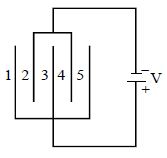
Five similar condenser plates, each of area $A$, are placed at equal distance apart and are  connected to a source of $e.m.f.$ $V$ as shown in the following diagram. The charge on the  plates $1$ and $4$ will be:-
The current in a coil decreases from $1 \,A$ to $0.2\, A$. In $10\,sec$. Calculate the coefficient of self inductance. If induced $e.m.f.$ is $0.4\, volt$......$H$
Capacitance (in $F$) of a spherical conductor with radius $1\, m$ is
In an interference pattern the $(n + 4)^{th}$ blue bright fringe and $n^{th}$ red bright fringe are formed at the same spot. If red and blue light have the wavelength of $7800\,\mathop A\limits^o $ and $5200\,\mathop A\limits^o $ then value of $n$ should be
A thin circular disc of mass $M$ and radius $R$ is rotating in a horizontal plane about an axis passing through its centre and perpendicular to its plane with angular velocity $\omega$. If another disc of same dimensions but of mass $\mathrm{M} / 2$ is placed gently on the first disc co-axially, then the new angular velocity of the system is :
A block is resting on a piston which executes simple harmonic motion with a period $2.0 \,s$. The maximum velocity of the piston, at an amplitude just sufficient for the block to separate from the piston is .......... $ms ^{-1}$
The longitudinal strain is only possible in
In the given reaction $'x$' is

$C{H_3} - C \equiv CH\xrightarrow{{Excess\,\, HCl}}\left( A \right)\xrightarrow{{{H_2}O/O{H^\Theta }}}\left( x \right)$
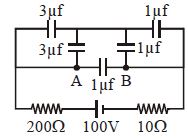
Find potential difference between $A$ and $B$ in given circuit in steady state ............... $\mathrm{V}$
A stone weighing $1$ kg and sliding on ice with a velocity of $2$ m/s is stopped by friction in $10$ sec. The force of friction (assuming it to be constant) will be ......... $N$