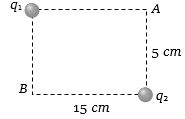
$n$ the rectangle, shown below, the two corners have charges ${q_1} = - 5\,\mu C$ and ${q_2} = + 2.0\,\mu C$. The work done in moving a charge $ + 3.0\,\mu C$ from $B$ to $A$ is.........$J$ $(1/4\pi {\varepsilon _0} = {10^{10}}\,N{\rm{ - }}{m^2}/{C^2})$
Diffcult
Download our app for free and get started
(a) Work done $W = 3 \times {10^{ - 6}}({V_A} - {V_B});$ where
${V_A} = {10^{10}}\left[ {\frac{{( - 5 \times {{10}^{ - 6}})}}{{15 \times {{10}^{ - 2}}}} + \frac{{2 \times {{10}^{ - 6}}}}{{5 \times {{10}^{ - 2}}}}} \right] = \frac{1}{{15}} \times {10^6}\,volt$
and ${V_B} = {10^{10}}\left[ {\frac{{(2 \times {{10}^{ - 6}})}}{{15 \times {{10}^{ - 2}}}} - \frac{{5 \times {{10}^{ - 6}}}}{{5 \times {{10}^{ - 2}}}}} \right] = - \frac{{13}}{{15}} \times {10^6}\,volt$
$W = 3 \times {10^{ - 6}}\left[ {\frac{1}{{15}} \times {{10}^6} - \left( { - \frac{{13}}{{15}} \times {{10}^6}} \right)} \right]= 2.8 \,J$
${V_A} = {10^{10}}\left[ {\frac{{( - 5 \times {{10}^{ - 6}})}}{{15 \times {{10}^{ - 2}}}} + \frac{{2 \times {{10}^{ - 6}}}}{{5 \times {{10}^{ - 2}}}}} \right] = \frac{1}{{15}} \times {10^6}\,volt$
and ${V_B} = {10^{10}}\left[ {\frac{{(2 \times {{10}^{ - 6}})}}{{15 \times {{10}^{ - 2}}}} - \frac{{5 \times {{10}^{ - 6}}}}{{5 \times {{10}^{ - 2}}}}} \right] = - \frac{{13}}{{15}} \times {10^6}\,volt$
$W = 3 \times {10^{ - 6}}\left[ {\frac{1}{{15}} \times {{10}^6} - \left( { - \frac{{13}}{{15}} \times {{10}^6}} \right)} \right]= 2.8 \,J$

Download our appand get started for free
Experience the future of education. Simply download our apps or reach out to us for more information. Let's shape the future of learning together!No signup needed.*
Similar Questions
- 1Three concentric conducting spherical shells have radius $ r, 2r$ and $3r$ and $Q_1, Q_2$ and $Q_3$ are final charges respectively. Innermost and outermost shells are already earthed as shown in figure. Choose the wrong statement.View Solution

- 2A negatively charged plate has charge density of $2 \times {10^{ - 6}}\,C/{m^2}$. The initial distance of an electron which is moving toward plate, cannot strike the plate, if it is having energy of $200\,eV$View Solution
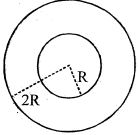
- 3Consider the shown system of two concentric thin metal shells. The inner hell has charge $Q$, while the outer shell is neutral. Potential difference between the shells is $V$. If the shell are joined by metal wire, then potential of the inner shell isView Solution
- 4View SolutionWhich of the following statements is true about the flow of electrons in an electric circuit?
- 5View SolutionWork done in moving a positive charge on an equipotential surface is
- 6On rotating a point charge having a charge $q$ around a charge $Q$ in a circle of radius $r$. The work done will beView Solution
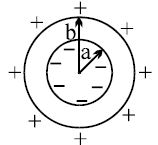
- 7An empty thick conducting shell of inner radius $a$ and outer radius $b$ is shown in figure.If it is observed that the inner face of the shell carries a uniform charge density $-\sigma$ and the surface carries a uniform charge density $ '\sigma '$View Solution
If the charge $q_A$ is slowly moved inside the shell, then choose the statement$(s)$
- 8The diagram shows a small bead of mass $m$ carrying charge $q$. The bead can freely move on the smooth fixed ring placed on a smooth horizontal plane. In the same plane a charge $+Q$ has also been fixed as shown. The potential atthe point $P$ due to $+Q$ is $V$. The velocity with which the bead should projected from the point $P$ so that it can complete a circle should be greater thanView Solution

- 9A ball of mass $1\, g$ and charge ${10^{ - 8}}\,C$ moves from a point $A$. where potential is $600\, volt$ to the point $B$ where potential is zero. Velocity of the ball at the point $B$ is $20\, cm/s$. The velocity of the ball at the point $A$ will beView Solution
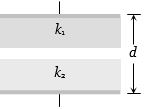
- 10Two dielectric slabs of constant ${K_1}$ and ${K_2}$ have been filled in between the plates of a capacitor as shown below. What will be the capacitance of the capacitorView Solution