A ball of mass $1\, g$ and charge ${10^{ - 8}}\,C$ moves from a point $A$. where potential is $600\, volt$ to the point $B$ where potential is zero. Velocity of the ball at the point $B$ is $20\, cm/s$. The velocity of the ball at the point $A$ will be
Medium


Download our appand get started for free
Experience the future of education. Simply download our apps or reach out to us for more information. Let's shape the future of learning together!No signup needed.*
Similar Questions
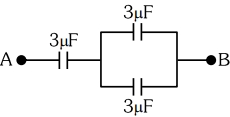
- 1The equivalent capacitance of the system shown in the following circuit is $...........\mu F$View Solution
- 2In a certain region of space, variation of potential with distance from origin as we move along $x$-axis is given by $V=8 x^2+2$, where $x$ is the $x$-coordinate of a point in space. The magnitude of electric field at a point $(-4,0)$ is .......... $V / m$View Solution
- 3A capacitor of capacitance $C$ is charged to a potential difference $V$ from a cell and then disconnected from it. A charge $+Q$ is now given to its positive plate. The potential difference across the capacitor is now $Q$View Solution
if $V < CV$
- 4A square of side ‘$a$’ has charge $Q$ at its centre and charge ‘$q$’ at one of the corners. The work required to be done in moving the charge ‘$q$’ from the corner to the diagonally opposite corner isView Solution
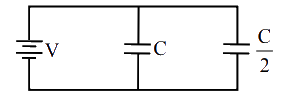
- 5Two condensers, one of capacity $C$ and other of capacity $C/2$ are connected to a $V-$ volt battery, as shown in the figure. The work done in charging fully both the condensers isView Solution
- 6Dipole having dipole moment $4\,C-m$ is placed on origin along $x-$ axis. Point charge of $8\,\mu C$ is fixed at $(4, 0, 0)$ . Now dipole is rotated by an angle of $\frac{\pi }{2}$ . Find the work done (in $mJ$ ) in rotating the dipole.......$mJ$View Solution
- 7View SolutionAssertion : A metallic shield in form of a hollow shell may be built to block an electric field.
Reason : In a hollow spherical shield, the electric field inside it is zero at every point.
- 8Two capacitors of capacities $2 {C}$ and ${C}$ are joined in parallel and charged up to potential ${V}$. The battery is removed and the capacitor of capacity $C$ is filled completely with a medium of dielectric constant ${K}$. The potential difference across the capacitors will now beView Solution
- 9The distance between two plates of a capacitor is $d$ and its capacitance is $C _1$, when air is the medium between the plates. If a metal sheet of thickness $\frac{2 d }{3}$ and of same area as plate is introduced between the plates, the capacitance of the capacitor becomes $C _2$. The ratio $\frac{ C _2}{ C _1}$ is:View Solution
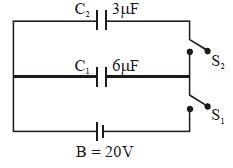
- 10In the circuit shown here $C_1 = 6\,\mu F, C_2 = 3 \,\mu F$ and battery $B = 20\,V$. The switch $S_1$ is first closed. It is then opened and afterwards $S_2$ is closed. What is the charge (in $\mu F$)finally on $C_2$ ?View Solution