Question
Name a cell that is found arrested in diplotene stage for months and years. Comment in 2-3 lines how it completes cell cycle?

Answer

Meiotic arrest at diplotene stage commonly occurs in mammalian occytes. In females, meiosis starts in the embryo and proceeds as for as diplotene, when the chromosomes become diffused and the cells are referred to as being in the dictuate stage. This arrest is under hormonal control. In many amphibian oocytes binds and insects with a long period of immaturity, the oocyte may be arrested in the dictyate stage for many years and spend a prolonged period in diplotene. This stage is characterized by formation of lamp brush chromosomes where intense RNA synthesis occurs and most of the genes in the DNA loops are actively transcribed and expressed.

Need a full question paper?

Generate a complete, print-ready paper with questions like this in minutes — across 16+ boards, with answer keys.
Start Generating Free

Similar questions

Vidhi attended the guest lecture on photosynthesis with her biology teacher. Guest for the seminar explained the basic functioning of chloroplast in the photosynthetic processes. As students from different schools attended the seminar. The guest for the lecture asked all students to put forward their queries regarding the topic. Vidhi stood up and asked him that, she is unable to understand the division of labour in the chloroplast. He appreciated her doubts and explained her about the same.
  1. What do you understand by the division of labour in chloroplast?
  2. How the different pigments are involved in photosynthesis?
  3. What is the significance of photosynthesis for animals?
  4. Elucide the value shown by Vidhi as a good biology student?
Describe the structure and importance of ligaments in humans.
Draw labelled diagrams of.
Alternation of generation in Angiosperm.
The essential functions of roots are anchorage and absorption of water and minerals in the terrestrial plant. What functions are associated with the roots of aquatic plants. How are roots of aquatic plants and terrestrial plants different?
Give comparison between the following:
$C _3$ and $C _4$ pathways
(b) Cyclic and non-cyclic photophosphorylation
(c) Anatomy of leaf in $C _3$ and $C _4$ plants
Describe the factors affecting enzyme activity.
Explain various steps of respiration.
Give comparative depscription in detail about striated, unstriated and cardiac muscles.
Draw labelled diagram of Neuron.
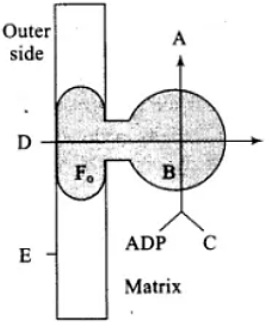
Given below is a diagram showing ATP synthesis during aerobic respiration, replace the symbols A, B, C, D and E by appropriate terms given in the box.

Image
F1, Particle, Pi, 2H+, Inner mitochondrial membrane, ATP, Fo particle, ADP