Question types

Cell Cycle and Cell Division question types

392 questions across 5 question groups — pick any mix to generate a BIOLOGY paper with step-by-step answer keys.

392
Questions
5
Question groups
5
Question types
Sample Questions

Cell Cycle and Cell Division questions

One sample from each question group in this chapter. Select any group above to see the full set with answer keys.
Crossing over in diploid organism is responsible for:
  • A
    Dominance of genes.
  • B
    Linkage between genes.
  • C
    Segregation of alleles.
  • D
    Recombination of linked alleles.
View full solution
Karyokinesis is the term used for:
  • A
    Division of cytoplasm.
  • B
    Division of nucleoplasm.
  • C
    Division of nucleus.
  • D
    Separation of daughter chromosomes.
View full solution
Choose the correct sequence.
  1. Pachytene
  2. Zygotene
  3. Leptotene
  4. Diakinesis
  5. Diplotene
    • A
    • C, B, A, D, E
  1. B
  2. C, A, B, E, D
  3. C
  4. C, B, A, E, D
  5. D
  6. D, B, C, E, A
  7. View full solution
    Describe the events taking place during interphase.
    View full solution
    Name the stage of cell cycle at which one of the following events occur:
    Chromosomes are moved to spindle equator.
    View full solution
    Name the stage of cell cycle at which one of the following events occur:
    Crossing over between homologous chromosomes takes place.
    View full solution
    What is Go (quiescent phase) of cell cycle?
    View full solution
    Name the stage of cell cycle at which one of the following events occur:
    Centromere splits and chromatids separate.
    View full solution
    Distinguish cytokinesis from karyokinesis.
    View full solution
    Describe the following:
    Bivalent
    Draw a diagram to illustrate your answer.
    View full solution
    Describe the following:
    Chiasmata
    Draw a diagram to illustrate your answer.
    View full solution
    Describe the following:
    synapsis
    Draw a diagram to illustrate your answer.
    View full solution
    Discuss with your teacher about:
    haploid insects and lower plants where cell-division occurs, and
    View full solution
    Q 163 Marks Question3 Marks
    Distinguish anaphase of mitosis from anaphase I of meiosis.
    View full solution
    Q 173 Marks Question3 Marks
    Find examples where the four daughter cells from meiosis are equal in size and where they are found unequal in size.
    View full solution
    Q 183 Marks Question3 Marks
    Analyse the events during every stage of cell cycle and notice how the following two parameters change.
    Amount of DNA content (C) per cell.
    View full solution
    Q 193 Marks Question3 Marks
    Can there be DNA replication without cell division?
    View full solution
    Q 203 Marks Question3 Marks
    Analyse the events during every stage of cell cycle and notice how the following two parameters change.
    Number of chromosomes (N) per cell.
    View full solution
    How does cytokinesis in plant cells differ from that in animal cells?
    View full solution
    List the main differences between mitosis and meiosis.
    View full solution
    What is the significance of meiosis?
    View full solution
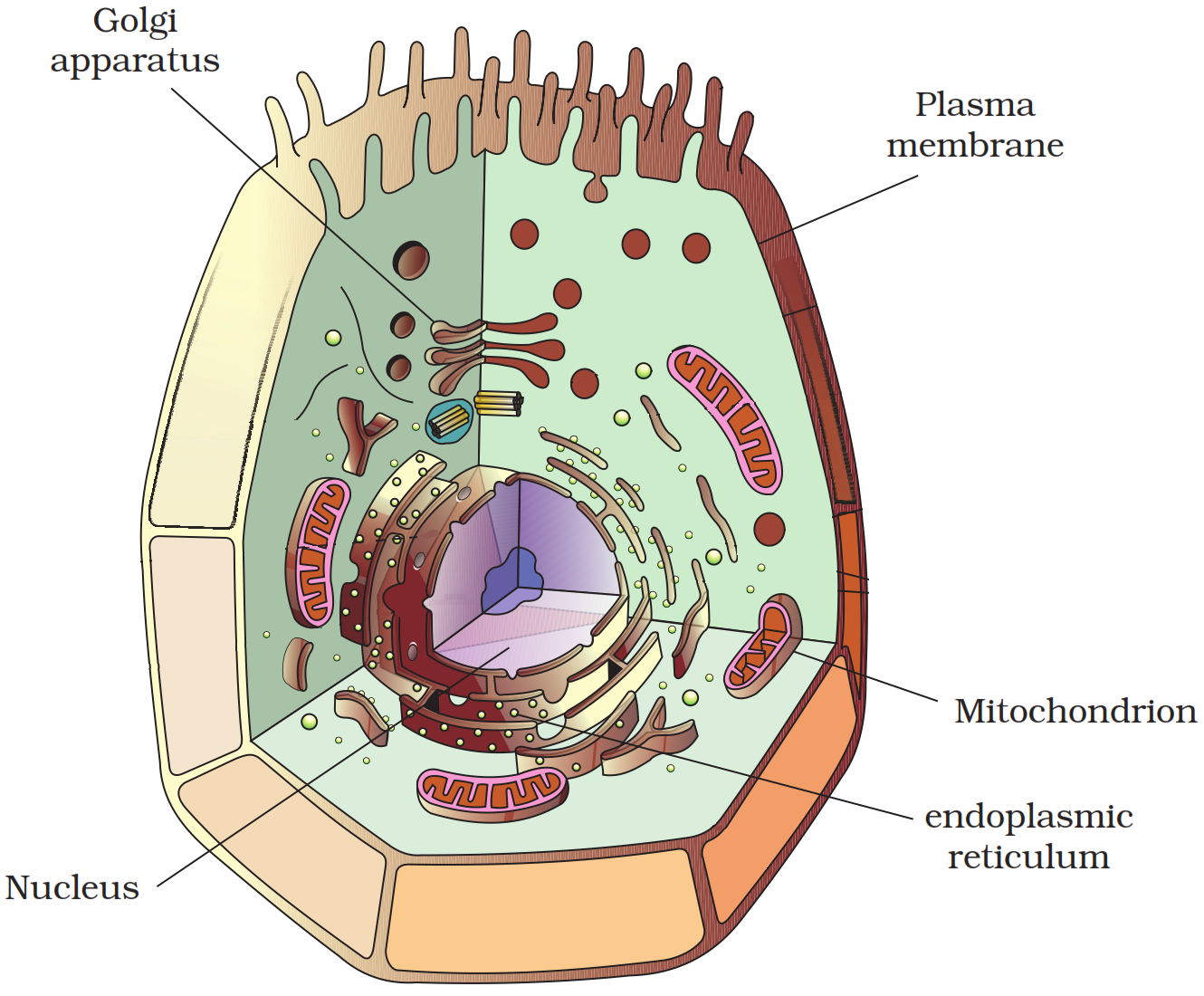
    The diagram shows some of the structures present in an animal cell.

    Which of these structures is responsible for,

    1. Manufacture of lipids and steroids.
    2. Release of energy.
    3. Manufacture of hormones and digestive enzymes.
    4. Production of spindle fibres in cell division.
    5. Endo and exocytosis?
    View full solution
    Manish while performing a practical in laboratory on Grams stain observed that one type of bacteria stained dark blue or purple in colour, while the other type of bacteria did not retain the crystal violet dye even after staining again and again. Instead it keeps on loosing the dye on washing. He rushed to his teacher for showing the specimen.

    His teacher explained that there is nothing to get worried about. As different kinds ofbacteria are found.

    1. What is the basis of classifying bacteria.
    2. What is the basic difference between Gram positive and Gram negative bacteria.
    3. Name one Gram positive and one Gram negative bacteria.
    4. What values are shown by Manish's teacher?
    View full solution
    Browse all question groups ↑

    Generate a Cell Cycle and Cell Division paper free

    Pick question groups from the list above, set marks and difficulty, and export a branded PDF with step-by-step answer keys. First 3 chapters free — no signup.

    Download App
    Generate Paper FreeAll BIOLOGY chapters