Question
  1. Name the em waves which are suitable for radar systems used in aircraft navigation. Write the range of frequency of these waves.
  2. If the earth did not have atmosphere, would its average surface temperature be higher or lower than what it is now? Explain.
  3. An em wave exerts pressure on the surface on which it is incident. Justify.
Answer

  1. Frequency range $10^{10}Hz$ to $10^{12}Hz.$
  2. Average surface temperature will be lower. This is because there will be no greenhouse effect in absence of atmosphere.
  3. An electromagnetic wave exerts pressure on the surface on which it is incident because these waves carry both energy and momentum.

Need a full question paper?

Generate a complete, print-ready paper with questions like this in minutes — across 16+ boards, with answer keys.

Start Generating Free

Similar questions

A coil of cross $-$ sectional area $A$ lies in a uniform magnetic field $B$ with its plane perpendicular to the field. In this position the normal to the coil makes an angle of $0^\circ$ with the field. The coil rotates at a uniform rate to complete one rotation in time $T$. Find the average induced emf in the coil during the interval when the coil rotates:
$i.$ from $0^{\circ}$ to $90^{\circ}$ position
$ii.$ from $90^{\circ}$ to $180^{\circ}$ position
$iii.$ from $180^{\circ}$ to $270^{\circ}$ and
$iv.$ from $270^{\circ}$ to $360^{\circ}$
A sample of paramagnetic salt contains $2.0 \times 10^{24}$ atomic dipoles each of dipole moment $1.5 \times 10^{-23} \mathrm{~J} \mathrm{~T}^{-1}$. The sample is placed under a homogeneous magnetic field of 0.64 T , and cooled to a temperature of 4.2 K . The degree of magnetic saturation achieved is equal to $15 \%$. What is the total dipole moment of the sample for a magnetic field of 0.98 T and a temperature of 2.8 K ? (Assume Curie's law)
A man uses a concave mirror for shaving. He keeps his face at a distance of 25cm from the mirror and gets an image which is 1.4 times enlarged. Find the focal length of the mirror.
  1. Draw the circuit diagram of an n-p-n transistor amplifier in common emitter configuration.
  2. Derive an expression for voltage gain of the amplifier and hence show that the output voltage is in opposite phase with the input voltage.
  1. Explain briefly the process of emission of light by a Light Emitting Diode (LED).
  2. Which semiconductors are preferred to make LEDs and why?
  3. Give two advantages of using LEDs over conventional incandescent lamps.
Prove that $I _{ D }=\epsilon_0 \frac{d}{d t}\left(\phi_{ E }\right)$, when symbols have their usual meanings.
Derive the equation for the torque acting on a current carrying loop placed at an angle $\theta$ with uniform magnetic field $(\vec{B})$.
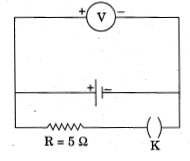
Write any two factors on which internal resistance of a cell depends. The reading on a high resistance voltmeter, when a cell is connected across it, is 2.2 V. When the terminals of the cell are also connected to a resistance of 5 Ω as shown in the circuit, the voltmeter reading drops to 1.8 V. Find the internal resistance of the cell.
A double convex lens, made from a material of refractive index $\mu_1,$ is immersed in a liquid of refractive index $\mu_2$ where $\mu_1>\mu_2.$ What change, if any, would occur in the nature of the lens?
Suppose the resistance of the coil in the preivous problem is $25\Omega.$ Assume that the coil moves with uniform velocity during its removal and restoration. Find the thermal energy developed in the coil during:
  1. Its removal.
  2. Its restoration.
  3. Its motion.