Question
Name the following diagram and explain the concept behind them.
Image

Answer

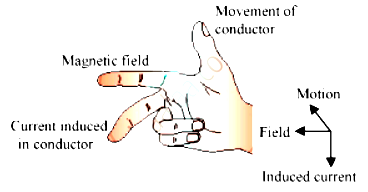
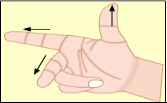
It represents Fleming's right hand rule used for finding the direction of induced current with respect to the directions of the magnetic field and motion of the conductor.

The direction of current induced in a conductor can be obtained by holding the thumb, the index finger, and the middle finger of your right hand mutually perpendicular to each other. In this situation, the thumb indicates the direction of the motion of the conductor, the index finger points along the magnetic field, and the middle finger points along the current induced in the conductor.

Need a full question paper?

Generate a complete, print-ready paper with questions like this in minutes — across 16+ boards, with answer keys.

Start Generating Free

Similar questions

Explain the magnetic field created around a straight current carrying conductor with the help of a diagram.
Match the terms given in column I with those given in column II:
Column I Column II
i. Fossil a. A famous evolutionist
ii. A theory of evolution b. Survial of the fitted
iii. Probale ancestor of birds c. Petried remains of the perhistoric life
iv. Charles Dawin d. Father of genetics
v. Gregor Mendal e. Archaeopteryx
The organ A which is located inside the skull of our body is protected by a bony shell B. It is surrounded by three layers membranes C. The spaces between these layers are filled with a liquid D which protects organ A from mechanical shocks. Organ A in combination with another organ E makes up the central nervous system.
  1. What is organ A?
  2. What are B, C and D?
  3. Name the organ E.
  4. While walking barefoot, if we happen to step on a sharp piece of stone, we immediately lift our foot up. Which of the two organs: A or E, is directly involved in this action?
  5. If we step out from a darkened room into bright sunlight, we close our eyes for a moment. Which of the two organs: A or E, is directly involved in this action?
Write the names of biodiversity hot spots?
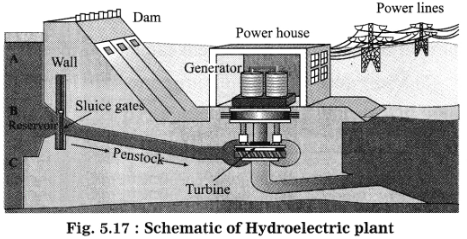
The schematic of hydroelectric plant is shown in Figure. Water from about middle of the total height of the dam is taken to the turbine, as shown by point B in the diagram.
Image
(i) With reference to point B, potential energy of how much water reservoir in the dam will be converted into kinetic energy?
(ii) What will be the effect on electricity generation, if the channel taking water to turbine starts at point A?
(iii) What will be the effect on electricity generation, if the channel taking water to turbine starts at point C?
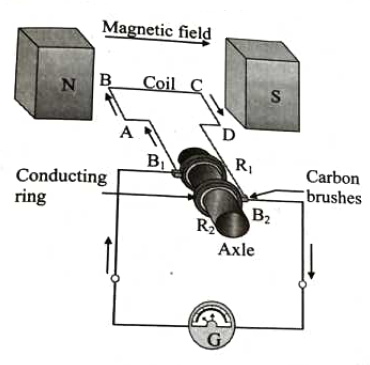
Observe the following diagram and write the answers of the given sub-questions:
Image

i. Which instrument the above figure shows?
ii. Which rule is used to determine the direction of the current produced?
iii. State the rule.
iv. In which direction ( $B_1$ to $B_2$ or $B_2$ to $B_1$ ) will the current flow in the external circuit in that situation?
v. What change will have to be made in the coil for increasing the current several times without changing the magnet?
Using the law of conservation of energy, obtain the expression for the escape velocity
What are the demerits of Mendeleev’s periodic table$?$
What is the reaction called when oxidation and reduction take place simultaneously? Explain with one example.
A red-brown metal $X$ forms a salt $XSO_4$. When hydrogen sulphide gas is passed through an aqueous solution of $XSO_4,$ then a black precipitate of $XS$ is formed alongwith sulphuric acid solution.
  1. What could the salt $XSO_4$ be?
  2. What is the colour of salt $XSO_4?$
  3. Name the black precipitate $XS.$
  4. By using the formula of the salt obtained in $(a)$ above, write an equation of the reaction which takes place when hydrogen sulphide gas is passed through its aqueous solution.
  5. What type of chemical reaction takes place in this case?