Question
  1. Name the two greenhouse gases.
  2. What is global warming?

Answer

  1. Carbon dioxide and methane are green house gases.
  2. Global warming when concentration of green house gases like $\mathrm{CO}_2$ increases, these gases trap infrared radiations of sun and increase the temperature of the earth i.e. increase green house effect causing global warming. Global warming leads to abnormal changes in climate.

Need a full question paper?

Generate a complete, print-ready paper with questions like this in minutes — across 16+ boards, with answer keys.
Start Generating Free

Similar questions

Assign oxidation number to the underlined elements in the following species:$\text{H}_4\text{P}_2\text{O}_7$
Given that the enthalpy of formation of $\mathrm{H}_2 \mathrm{O}$ is $-68 \mathrm{kcal} / \mathrm{mol}$. Calculate the enthalpy of formation of OH ions.
  1. What is the oxidation number of Fe in $Fe_3O_4$?
$\text{H}^++\text{MnO}_4^-+\text{Fe}^{2+}\xrightarrow{ \ \ \ \ \\ \ \ }\text{Fe}^{3+}+\text{Mn}^{2+}+\text{H}_2\text{O}\\ \ \ \ \ \ \ \ \ \ \ \ \ \ \ \ \ \ \ \ \ \ \ \ \ \ \ \ \ \ \ \ \ \ \ \ \ \ \ \ \ \ \ \ \ \ \ \ \ \ \ \ \ \ \ \text{(Acidic medium)}$
  1. Balance the equation.
What happens when:
  1. Diborane burns in presence of oxygen.
  2. Diborane is hydrolysed.
One of the assumptions of kinetic theory of gases is that there is no force of attraction between the molecules of a gas. State and explain the evidence that shows that the assumption is not applicable for real gases.

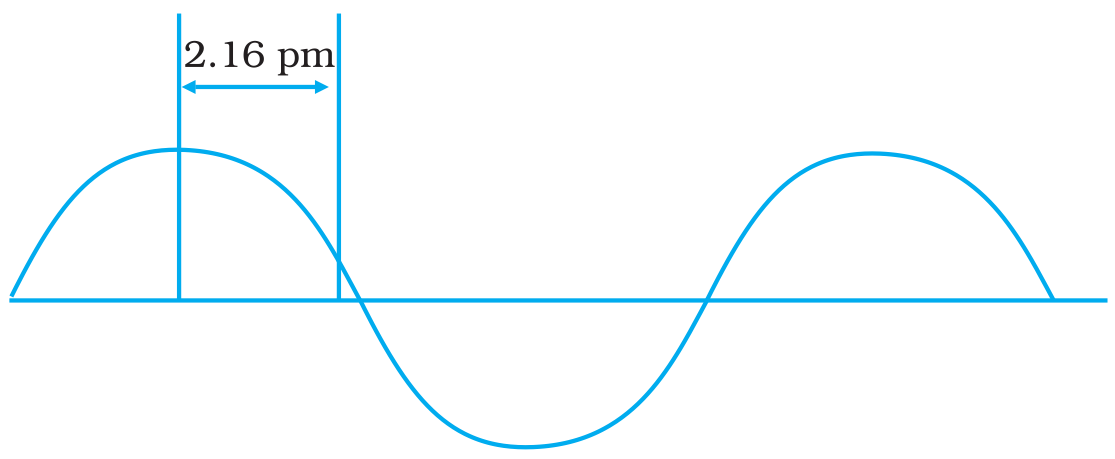
A hypothetical electromagnetic wave is shown in Fig. Find out the wavelength of the radiation.
Give suitable reasons for the following:
i. $\left[\mathrm{SiF}_6\right]^{2-}$ is known whereas $\left[\mathrm{SiCl}_6\right]^{2-}$ not.
ii. Diamond is covalent, yet it has high melting point.
How can you apply green chemistry for the following:To reduce the consumption of petrol and diesel.
What is light soda ash? Why is it called so?
Calculate the temperature above which the reduction of lead oxide in the following reaction becomes spontaneous:
PbO(s) + C(s) → Pb(s) + CO(g)
Given: $[\Delta\text{H}=108.4\text{kJ mol}^{-1};\ \Delta\text{S}=190\text{J K}^{-1}\text{mol}^{-1}]$