MCQ
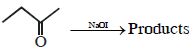
$NaOH/{H^ + }$ reacts with
- A${C_6}{H_5}OC{H_3}$
- B$C{H_3}OH$
- ✓$C{H_3} - \mathop C\limits^{\mathop {||}\limits^O } - C{H_3}$
- D${C_2}{H_5}OH$
Generate a complete, print-ready paper with questions like this in minutes — across 16+ boards, with answer keys.
Statement $I$: The boiling point of hydrides of Group $16$ elements follow the order
$\mathrm{H}_2 \mathrm{O}>\mathrm{H}_2 \mathrm{Te}>\mathrm{H}_2 \mathrm{Se}>\mathrm{H}_2 \mathrm{~S}$.
Statement $II$: On the basis of molecular mass, $\mathrm{H}_2 \mathrm{O}$ is expected to have lower boiling point than the othe members of the group but due to the presence of extensive $\mathrm{H}$-bonding in $\mathrm{H}_2 \mathrm{O}$, it has higher boiling point.
In the light of the above statements, choose the correct answer from the options given below:
$(i)$ Pure solvent $\to$ separated solvent molecules $\Delta$ $H_1$
$(ii)$ Pure solute $\to$ separated solute molecules$\Delta$ $H_2$
$(iii)$ Separated solvent and solute molecules $\to$ solution $\Delta H_3$ Solution so formed will be ideal if
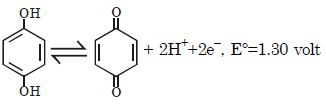
What will be the electrode potential at $pH = 3$