MCQ
Phenol on reaction with NH3​ gives:
  • A
    Aniline
  • B
    Nitrobenzene
  • C
    Benzaldehyde
  • D
    Anilinium chloride

Answer

  1. Aniline

Explanation:

Phenol on reaction with ammonia gives aniline. In this reaction, -OH group is replaced with −NH2​ group.

Need a full question paper?

Generate a complete, print-ready paper with questions like this in minutes — across 16+ boards, with answer keys.
Start Generating Free

Similar questions

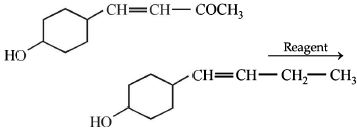
In the given transformation, which of the following is the most appropriate reagent ?
$NaClO$ solution reacts with ${H_2}S{O_3}$ as, $NaClO + {H_2}S{O_3} \to NaCl + {H_2}S{O_4}$. A solution of $NaClO$ used in the above reaction contained $15\,g$ of $NaClO$ per litre. The normality of the solution would be
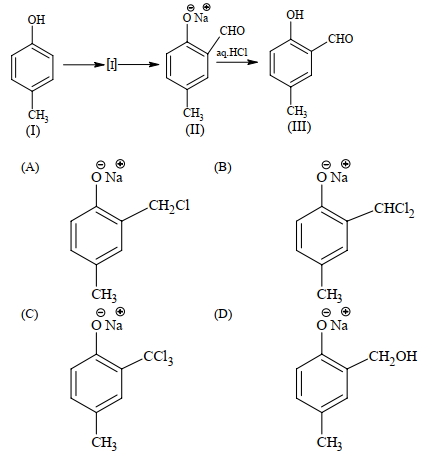
Reimer-Tiemann reaction introduces an aldehyde group, on to the aromatic ring of phenol, ortho to the hydroxyl group. This reaction involves electrophilic aromatic substitution. This is a general method for the synthesis of substituted salicyladehydes as depicted below.

$Image$

$1.$ Which one of the following reagents is used in the above reaction?

$(A)$ aq. $\mathrm{NaOH}+\mathrm{CH}_3 \mathrm{Cl}$

$(B)$ aq. $\mathrm{NaOH}+\mathrm{CH}_2 \mathrm{Cl}_2$

$(C)$ aq. $\mathrm{NaOH}+\mathrm{CHCl}_3$

$(D)$ aq. $\mathrm{NaOH}+\mathrm{CCl}_4$

$2.$ The electrophile in this reaction is

$(A)$ : $\mathrm{CHCl}$ $(B)$ ${ }^{+} \mathrm{CHCl}_2$

$(C)$ $\mathrm{CCl}_2$ $(D)$. $\mathrm{CCl}_3$

$3.$ The structure of the intermediate $I$ is

$Image$

Give the answer question $1, 2$ and $3.$
Nucleic acids are called acids mainly because of the presence of__________.
In which of the following compounds iron has lowest oxidation state
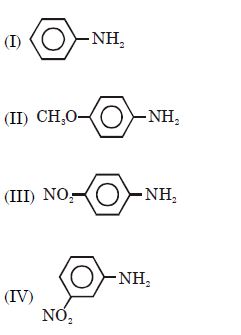
The correct order of decreasing basic strength of the above compounds is
A hydrogen gas electrode is made by dipping platinum wire in a solution of $HCl$ of $pH = 10$ and by passing hydrogen gas around the platinum wire at one atm pressure. The oxidation potential of electrode would be .......... $V.$
Transitional elements exhibit variable valencies because they release electrons from the following orbits:
In which solution, solubility of solute decreases with increase of temperature?
In the following reactions, products $A$ and $B$ are