Question
Nematode specific genes were introduced into the tobacco host plant using a vector:
  1. pBR 322.
  2. Plasmid.
  3. Bacteriophage.
  4. Agrobacterium.

Answer

  1. Agrobacterium.

Need a full question paper?

Generate a complete, print-ready paper with questions like this in minutes — across 16+ boards, with answer keys.

Start Generating Free

Similar questions

Read the following and answer any four questions from (i) to (v) given below:
Oral administration of small doses of hormones is contraceptive method used by the females. They are used in the form of tablets and hence called the pills. The oral pills are two types; mini pills and combined pills.
  1. Mini pills contain:
  1. Estrogen only.
  2. Progestin only.
  3. Combination of progesterone-estrogen.
  4. Inhibin.
  1. How do hormonal pills prevent pregnancy?
  1. By phagocytosing the sperms.
  2. By inhibiting ovulation.
  3. By preventing sperms from entering the vagina.
  4. All of these.
  1. Pill containing non-steroidal preparation, centchroman is:
  1. Mala D.
  2. Mala N.
  3. I-Pill.
  4. Saheli.
  1. Which among the following is incorrect for oral contraceptives?
  1. Oral pills alter the uterine endometrium and make it unsuitable for implantation.
  2. Oral pills have to be taken daily for 7 days starting within first five days of menstrual cycle.
  3. Oral pills increase the risk of intravascular clotting.
  4. Oral pills contain either progestin alone or combination of progestogen and estrogen.
  1. Assertion: Mala D, a combined contraceptive pill, have to be taken daily without a break.
Reason: Mala D contains synthetic progesterone and estrogen.
  1. Both assertion and reason are true, and reason is the correct explanation of assertion.
  2. Both assertion and reason are true, but reason is not the correct explanation of assertion.
  3. Assertion is true, but reason is false.
  4. Both assertion and reason are false.
Read the following and answer any four questions from (i) to (v) given below:
Rajesh, Ravi, and Rohit are roommates. 'They are doing their graduation. Few months back Ravi fell ill. it took him around 3 weeks to recover. Both his friends were absolutely healthy at that time. After sometime, Rajesh also fell ill from some other disease. This time Ravi and Rohit both contracted the same illness. Based on the above information, answer the following questions.
  1. Which of the following holds true for Ravi's illness?
  1. Ravi was suffering from a communicable disease that is transmitted through vector.
  2. Ravi was suffering from a communicable disease that is transmitted through faecal oral route.
  3. Ravi was suffering from a non-communicable disease like anaemia.
  4. Ravi was suffering from a non-communicable disease like Down's syndrome.
  1. Select the correct statement.
  1. Ravi contracted a disease caused by air borne microbes.
  2. Ravi could have suffered a nutritional disorder.
  3. Ravi suffered a non-contagious disease.
  4. Both (b) and (c)
  1. Which could be correctly said for Rajesh's illness?
  1. Rajesh's illness was due to a microbial infection.
  2. Rajesh's illness could be contagious or non-contagious.
  3. Rajesh's illness could be cured by antibiotics.
  4. All of these
  1. Which of the following may depicts Ravi's and Rajesh's illness?
S.no
Ravi
Rajesh
(a)
Which of the following may depicts Ravi's and Rajesh's illness?
Myocardial infection
(b)
Whooping cough
Tetanus
(c)
Gastritis
Rhinitis
(d)
Hypertensio
Thyroid
  1. Assertion: Diabetes mellitus is a non-communicable disease which can be completely cured.
Reason: Diabetes mellitus is caused by deficiency of aldosterone hormone.
  1. Both assertion and reason are true, and reason is the correct explanation of assertion.
  2. Both assertion and reason are true, but reason is not the correct explanation of assertion.
  3. Assertion is true, but reason is false.
  4. Both assertion and reason are false.
Distinguish between: Euchromatin and Heterochromatin.
Distinguish between : Lymphocytes and Monocytes.
Read the following and answer any four questions from (i) to (v) given below:
A typical angiospermic ovule is a small structure attached to the placenta by means of a stalk called funicle. The body of the ovule fuses with funicle in the region called hilum. Each ovule has one or two protective envelopes called integuments. Integuments encircle the nucellus except at the tip where a small opening called the micropyle is formed. Mature ovules are classified on the basis of funiculus. It can be orthotropous, anadromous, hernitropous, campylotropous, etc.
  1. The body of the ovule consists of a mass of parenchymatous cells called:
  1. Integuments.
  2. Nucellus.
  3. Hilum.
  4. Funiculus.
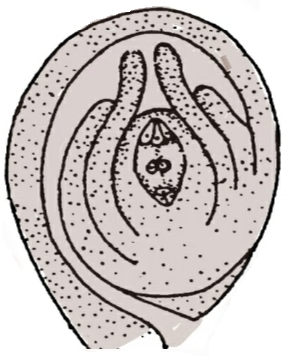
  1. Refer to the given figure and select the correct statement regarding it.
  1. This type of ovule is found in cactus.
  2. The micropyle comes to lie close to the funiculus due to unilateral growth of ovule.
  3. It is most common type of ovule found in the members of Chenopodiaceae.
  4. It is half inverted ovule.
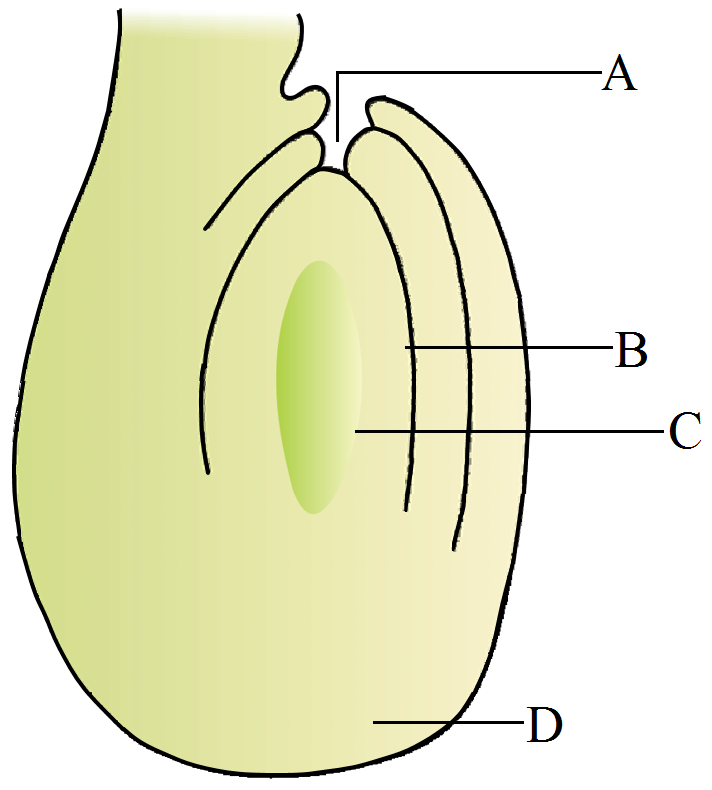
  1. Identify the parts labelled as A, B, C and D in the given figure and select the correct option.
S. No A B C D
(a) Chalaza Female gametophyte Embryo sac Micropyle
(b) Chalaza NuceIIus Embryo sac Micropyle
(c) Micropyle Egg Embryo sac Chalaza
(d) Micropyle Nucellus Embryo sac Chalaza
  1. Mature ovules are classified on the basis of funiculus. If micropyle lie close to the funiculus, the ovule is termed as:
  1. Orthotropous.
  2. Anatropous.
  3. Hemitropous.
  4. Campylotropous.
  1. In Asphodel us, ovule is:
  1. Unitegmic.
  2. Tritegmic.
  3. Bitegmic.
  4. Ategmic.
Column IColumn II
(1) Mechanical means(a) Saheli
(2) Physiological device(b) Jellies
(3) Chemical device(c) Vasectomy
(4) Permanent method(d) Diaphragm
Read the following and answer any four questions from (i) to (v) given below:
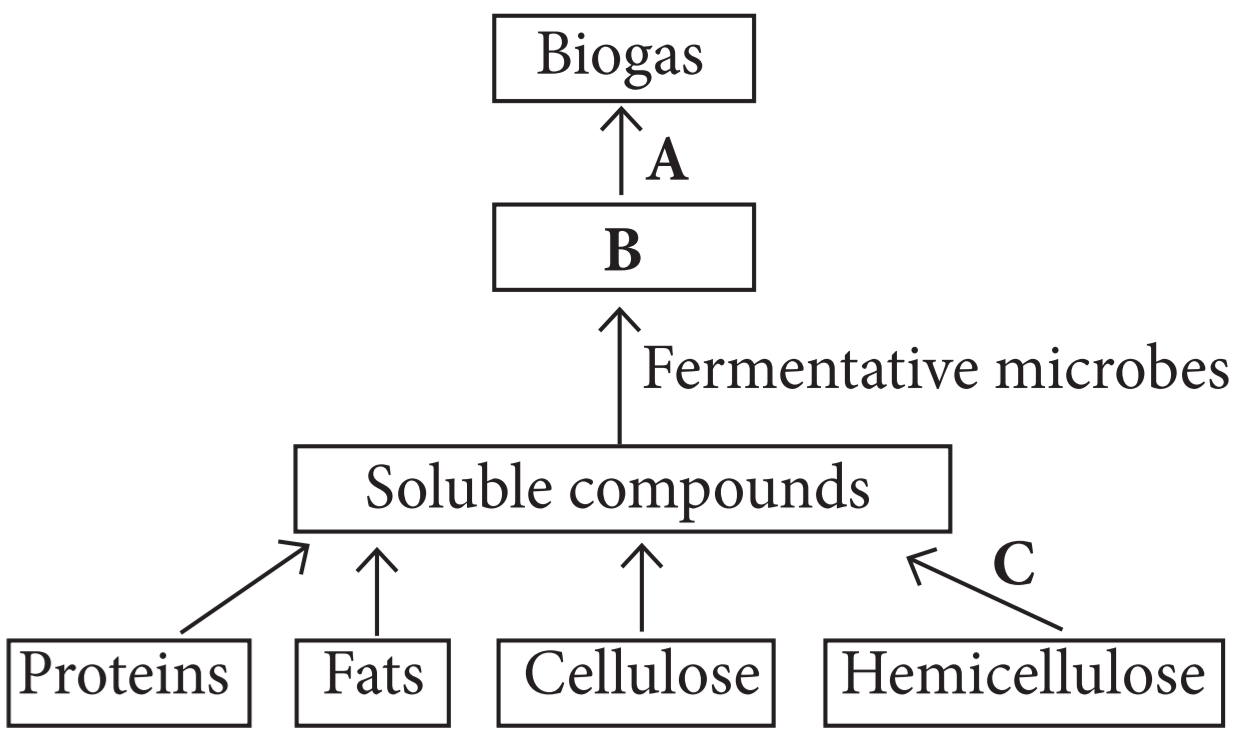
Villagers in a place near Chambur started planning to make power supply for agricultural purposes from cow dung. 'Tiley have started a biogas plant for the purpose. Study the flow chart for biogas production given below and answer the following questions.
  1. Biagas is composed of majorly:
  1. Methane, $CO_2$ and $O_2$​​​​​​​
  2. $CO_2, H_2S$ and H
  3. Methane, $CO_2​​​​​​​$
  4. $H_2S, H$ and $O_2​​​​​​​$
  1. In the given flow chart, 'A' denotes:
  1. Aerobic bacteria.
  2. Methanogenic bacteria.
  3. Cellulose degrading bacteria.
  4. Yeast and protozoa.
  1. What is represented by 'B' in the flow chart?
  1. Carbohydrates.
  2. Protein polymers.
  3. Organic acids.
  4. Fat globules.
  1. 'C' in the given flow chart causes:
  1. Aerobic breakdown of complex organic compounds.
  2. Anaerobic digestion of complex organic compounds.
  3. Fermentation of organic compounds.
  4. Fermentation of monomers.
  1. If 'A' is not added in the procedure.
  1. Methane will not be formed.
  2. $CO_2​​​​​​​$​​​​​​​ will not be formed.
  3. Organic compounds will not be converted to $H_2S$
  4. $O_2​​​​​​​$ will not be formed.
Read the following and answer any four questions from (i) to (v) given below:
A young couple married for 5 years is unable to bear a child in spite of not practicing any birth control method. Upon consultation, doctor advised them an assisted reproductive technology involving transfer of gametes into oviducts.
  1. Identify the technique adopted by the couple.
  1. ZIFT
  2. JUI
  3. GIFT
  4. ICSI
  1. What is the pre-requisite of this technique?
  1. Gamete formation should be normal.
  2. Fallopian tubes should be normal.
  3. Female should have thick endometrial lining.
  4. Male should be able to copulate the female.
  1. Assertion: GIFT is an in-vitro fertilisation technique.
Reason: In GIFT, gametes are fertilised outside the female body.
  1. Both assertion and reason are true, and reason is the correct explanation of assertion.
  2. Both assertion and reason are true, but reason is not the correct explanation of assertion.
  3. Assertion is true, but reason is false.
  4. Both assertion and reason are false.
  1. The procedure advised to couple involves the transfer of:
  1. Fertilised ovum.
  2. Embryo with 8 blastomeres.
  3. Sperms and unfertilised ovum.
  4. Embryo with 16 blastomeres.
  1. What is the success rate of this procedure?
  1. 30-50%
  2. < 20%
  3. 80-85%
  4. 27-30%
Distinguish between : Cranial nerves and Spinal nerves
CellsFunctions
(1) T-lymphocytes(a) Phagocytic in function
(2) Neutrophils(b) Responsible for Humoral immunity
(3) Eosinophils/Acidophils(c) Responsible for cell-medicated immunity
(4) B-lymphocytes(d) Anti-allergic [Antihistamine] in function