MCQ
Newton-second is the unit of
  • A
    Velocity
  • B
    Angular momentum
  • Momentum
  • D
    Energy

Answer

Correct option: C.
Momentum
c
(c) Impulse $=$ change in momentum $= F \times t$

So the unit of momentum will be equal to Newton-sec.

Need a full question paper?

Generate a complete, print-ready paper with questions like this in minutes — across 16+ boards, with answer keys.
Start Generating Free

Similar questions

A person has been using spectacles of power- $1.0$ diopter for distant vision and a separate reading glass of power $2.0$ diopters. What is the least distance of distinct vision for this person $.......cm$
The valence band and conduction band of a solid overlap at low temperature, the solid may be
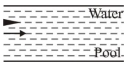
A bullet of mass $200\,g$ having initial kinetic energy $90\,J$ is shot inside a long swimming pool as shown in the figure. If it's kinetic energy reduces to $40\,J$ within 1s, the minimum length of the pool, the bullet has a to travel so that it completely comes to rest is $.....m$
The width of river is $1\; km$. The velocity of boat is $5\; km/hr$. The boat covered the width of river with shortest will possible path in $15 \;min$. Then the velocity of river stream is
A body starts from rest. What is the ratio of the distance travelled by the body during the $4^{th}$ and $3^{rd}$ second
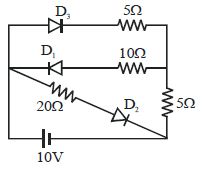
In the given circuit The current through the battery is........$A$
The velocities of three particles of masses $20\ g$, $30\ g$ and $50\ g$ are $10 \vec i,\,10\vec j,\,{\rm{and}}\,10\vec k$ respectively. The velocity of the centre of mass of the three particles is
For a transverse wave travelling along a straight line, the distance between two peaks (crests) is $5 \,m ,$ while the distance between one crest and one trough is $1.5 \,m$ The possible wavelengths (in $m$ ) of the waves are
An expression for rate of heat generated, if a current of $I$ ampere flows through a resistance of $R$ $\Omega$, is
Let $\theta$ be the angle between vectors $\vec{A}$ and $\vec{B}$. Which of the following figures correctly represents the angle $\theta$ ?