MCQ
Newton's law of motion apply to
  • A
    In accelerating frame
  • B
    In rotaional frame
  • C
    In non-inertial frame
  • In inertial frame

Answer

Correct option: D.
In inertial frame
D

Need a full question paper?

Generate a complete, print-ready paper with questions like this in minutes — across 16+ boards, with answer keys.

Start Generating Free

Similar questions

An object is moving with variable speed, then
A particle of mass $m$ is thrown upwards from the surface of the earth, with a velocity $u.$ The mass and the radius of the earth are, respectively, $M$ and $R.$  $G$ is gravitational constant and $g$ is acceleration due to gravity on the surface of the earth. The minimum value of $u$ so that the particle does not return back to earth, is
One mole of an ideal monoatomic gas undergoes the following four reversible processes:

Step $1$ It is first compressed adiabatically from volume $8.0 \,m ^{3}$ to $1.0 \,m ^{3}$.

Step $2$ Then expanded isothermally at temperature $T_{1}$ to volume $10.0 \,m ^{3}$.

Step $3$ Then expanded adiabatically to volume $80.0 \,m ^{3}$.

Step $4$ Then compressed isothermally at temperature $T_{2}$ to volume $8.0 \,m ^{3}$.

Then, $T_{1} / T_{2}$ is

Identify the wrong statement:
For a given gas at $1\,atm$ pressure, $rms$ speed of the molecules is $200\,m/s$ at $127\,^oC.$ At $2\,atm$ pressure and at $227\,^oC,$ the $rms$ speed of the molecules will be
The vectors $\vec{A}$ and $\vec{B}$ are such that

$|\vec{A}+\vec{B}|=|\vec{A}-\vec{B}|$

The angle between the two vectors is
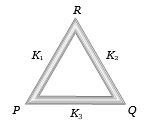
hree rods of same dimensions are arranged as shown in figure they have thermal conductivities ${K_1},{K_2}$ and${K_3}$ The points $P$ and $Q$ are maintained at different temperatures for the heat to flow at the same rate along $PRQ$ and $PQ$ then which of the following option is correct
A thin uniform rod of length $2\,m$. cross sectional area ' $A$ ' and density ' $d$ ' is rotated about an axis passing through the centre and perpendicular to its length with angular velocity $\omega$. If value of $\omega$ in terms of its rotational kinetic energy $E$ is $\sqrt{\frac{\alpha E}{ Ad }}$ then the value of $\alpha$ is $...........$
An ideal gas is expanded adiabatically at an initial temperature of $300 K$ so that its volume is doubled. The final temperature of the hydrogen gas is $(\gamma = 1.40)$
A body of mass $1\ kg$ is rotating in a vertical circle of radius $1m.$ What will be the difference in its kinetic energy at the top and bottom of the circle?
Take $g = 10\ m/ s^2$