Questions

M.C.Q (1 Marks)

Take a timed test

18 questions · auto-graded multiple-choice test.

MCQ 11 Mark
A car of mass 1000 kg passes on inclined curve of radius 90 m on a frictionless road. If the inclination of turn is $45^{\circ}$ then the speed of car is
  • A
    $20 m / s$
  • $30 m / s$
  • C
    $5 m / s$
  • D
    $10 m / s$
Answer
Correct option: B.
$30 m / s$
 (B)
$\begin{aligned}
v & =\sqrt{r g \tan \theta} \\
v & =\sqrt{90 \times 10 \times \tan 45^{\circ}} \\
& =30 m / s
\end{aligned}
$
Hence, correct option is (B).
View full question & answer
MCQ 21 Mark
The stationary reference frame situated on the earth's surface is
  • A
    inertial
  • Non-inertial but can generally be considered inertial
  • C
    Inertial or non inertial according to state
  • D
    Non-inertial
Answer
Correct option: B.
Non-inertial but can generally be considered inertial
B
View full question & answer
MCQ 31 Mark
Newton's law of motion apply to
  • A
    In accelerating frame
  • B
    In rotaional frame
  • C
    In non-inertial frame
  • In inertial frame
Answer
Correct option: D.
In inertial frame
D
View full question & answer
MCQ 41 Mark
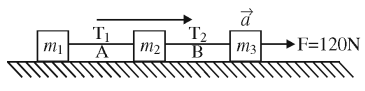
Three cubic shaped bodies whose masses are $m _1=20$ $kg , m _2=40 kg$ and $m _3=60 kg$ are kept on a frictionless surface as shown in figure. All three bodies are connected by an inextensible string. The values of $T _1$ and $T_2$ will be :
Image
  • A
    20 N and 10 N
  • 20 N and 60 N
  • C
    40 N and 20 N
  • D
    10 N and 20 N
Answer
Correct option: B.
20 N and 60 N
(B) Acceleration of system :
$\begin{aligned}
a & =\frac{F}{m_1+m_2+m_3}=\frac{120}{20+40+60} \\
a & =1 m / s^2 \\
T_1 & =m_1 a=20 \times 1=20 N \\
T_2 & =\left(m_1+m_2\right) a=(20+40) \times 1=60 N
\end{aligned}$
Hence, correct option is (B).
View full question & answer
MCQ 51 Mark
From which Newton's law the other two laws can be derived?
  • A
    First to second and third
  • First and third from second
  • C
    Third to first and second
  • D
    The above statement is impossible
Answer
Correct option: B.
First and third from second
B
View full question & answer
MCQ 61 Mark
A passeger sitting in a train facing towards the engine. The train is moving with a constant velocity. The passenger throws a ball upwards, then the ball will return:
  • in the hand of passenger
  • B
    in front of the passenger
  • C
    Next to the passenger
  • D
    Behind the passenger
Answer
Correct option: A.
in the hand of passenger
A
View full question & answer
MCQ 81 Mark
Newton's third law of motion gives.
  • A
    Definition of force
  • Property of force
  • C
    Definition of inertia
  • D
    Property of inertia
Answer
Correct option: B.
Property of force
B
View full question & answer
MCQ 91 Mark
The maximum value of static friction is called.
  • A
    Rotational friction
  • B
    Coefficient of friction
  • Limiting friction
  • D
    Limiting coefficient
Answer
Correct option: C.
Limiting friction
C
View full question & answer
MCQ 101 Mark
Static friction occurs.
  • always greater than kinetic friction
  • B
    equal to kinetic friction
  • C
    less than kinetic friction
  • D
    None of the above
Answer
Correct option: A.
always greater than kinetic friction
A
View full question & answer
MCQ 111 Mark
A man sitting in a lift feel his weight is zero, when:
  • A
    The lift is going up with a constant velocity.
  • B
    The lift is going up with uniform acceleration.
  • C
    The lift is going up with zero acceleration.
  • The lift is going down with zero acceleration.
Answer
Correct option: D.
The lift is going down with zero acceleration.
D
View full question & answer
MCQ 121 Mark
The mass of an elevator is 100 kg. It is falling freely, then the weight of a 100 kg body kept in it will be
  • A
    100 kg
  • B
    200 kg
  • 0 kg
  • D
    300 kg
Answer
Correct option: C.
0 kg
C
View full question & answer
MCQ 131 Mark
A rider sitting on the back of the running horse in the circus jumps and comes back on the horse because
  • A
    The speed is in a circular path
  • B
    There is inertia of stability
  • Inertia of motion
  • D
    It is impossible
Answer
Correct option: C.
Inertia of motion
C
View full question & answer
MCQ 141 Mark
A person jumping from a moving bus onto the road falls forward, the reason for this is
  • A
    Due to inertia of steady state, the road is left behind and the man moves forward.
  • Due to inertia of moving state, the upper part of person remains in motion while the feet come in stationary state due to coming in contact with the road.
  • C
    The person leans forward due to his old habit.
  • D
    Due to all of the above mentioned effects.
Answer
Correct option: B.
Due to inertia of moving state, the upper part of person remains in motion while the feet come in stationary state due to coming in contact with the road.
B
View full question & answer
MCQ 151 Mark
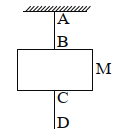
An object of mass $M$ is hung by a thread $A B$ and thread CD is hanging below the object. If end D is pulled down with a jerk then :
Image
  • A
    Thread AB will break.
  • B
    Thread CD will break.
  • Both the thread will break.
  • D
    Nothing can be said with certainty.
Answer
Correct option: C.
Both the thread will break.
C
View full question & answer
MCQ 161 Mark
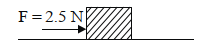
  • 2.5 N
  • B
    5 N
  • C
    7.5 N
  • D
    10 N
Answer
Correct option: A.
2.5 N
(A) Maximum friction force :
$\begin{array}{l}
f_{S, \max }=\mu_s R=\mu_s mg=0.4 \times 2 \times 9.8 \\
f_{s, \max }=7.84 N
\end{array}$
Since friction force is self adjusting force hence on applying a force of 2.5 N , the external friction force between the block and the floor will be 2.5 N .
Hence, correct option is (A).
View full question & answer
MCQ 171 Mark
Two forces of 10 N each are acting at an angle $\theta^{\circ}$ at a point. Their resultant force is 10 N . The value of $\theta$ will be.
  • A
    $0^{\circ}$
  • B
    $60^{\circ}$
  • $120^{\circ}$
  • D
    $180^{\circ}$
Answer
Correct option: C.
$120^{\circ}$
(C) Resultant force :
$\begin{aligned} F ^2 & = F _1^2+ F _2^2+2 F_1 F_2 \cos \theta \\ (10)^2 & =(10)^2+(10)^2+2 \times 10 \times 10 \times \cos \theta \\ 100 & =100+100+200 \cos \theta \\ -100 & =200 \cos \theta \\ \cos \theta & =-\frac{100}{200}=-\frac{1}{2}=\cos 120^{\circ}
\\ ∴\theta  =120^{\circ}\end{aligned}$
Hence, option (C) is correct.
View full question & answer
MCQ 181 Mark
A force $\vec{F}=4 t^3$ is applied on an object for the first two seconds. The linear momentum of object will increase.
  • $16 N- s$
  • B
    $8 N- s$
  • C
    $48 N- s$
  • D
    $32 N- s$
Answer
Correct option: A.
$16 N- s$
(A) Impulse acting on object :
$
\begin{aligned}
J & =\int_{t_1}^{t_2} F d t=\int_0^2 4 t^3 d t \\
J & =4\left[\frac{t^4}{4}\right]_0^2=\left[t^4\right]_0^2=2^4-0 \\
& =16 N-s
\end{aligned}
$
From the impulse-momentum theorem,
change in linear momentum $=$ Impulse $=16 Ns$
Hence, correct option is (A).
View full question & answer