MCQ
Newton's second law gives the measure of
  • A
    Acceleration
  • Force
  • C
    Momentum
  • D
    Angular momentum

Answer

Correct option: B.
Force
b
(b)$\overrightarrow F = m\overrightarrow a $

Need a full question paper?

Generate a complete, print-ready paper with questions like this in minutes — across 16+ boards, with answer keys.
Start Generating Free

Similar questions

When a mass is rotating in a plane about a fixed point, its angular momentum is directed along 
Wind is blowing in the north direction at speed of $2 \,\,m/s$ which causes the rain to fall at some angle with the vertical. With what velocity should a cyclist drive so that the rain appears vertical to him :
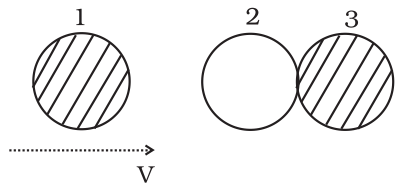
Two identical ball bearings in contact with each other and resting on a frictionless table are hit head-on by another ball bearing of the same mass moving initially with a speed V as shown in:

If the collision is elastic, which of the following is a possible result after collision?
A small disc of radius $2\, cm$ is cut from a disc of radius $6\, cm$. If the distance between their centres is $3.2\, cm$, what is the shift in the centre of mass of the disc ....... $cm$.
$STATEMENT- 1$ The total translational kinetic energy of all the molecules of a given mass of an ideal gas is $1.5$ times the product of its pressure and its volume. because

$STATEMENT-2$ The molecules of a gas collide with each other and the velocities of the molecules change due to the collision.

When $20\ \text{cal}$ of heat is supplied to a system, the increase in internal energy is $50J$. If the external work done is $35J$, the mechanical equivalent of heat is:
If a satellite of mass $400 \,kg$ revolves around the earth in an orbit with speed $200 \,m / s$ then its potential energy is .......... $MJ$
A light unstretchable string passing over a smooth light pulley connects two blocks of masses $m_1$ and $m_2$. If the acceleration of the system is $\frac{g}{8}$, then the ratio of the masses $\frac{\mathrm{m}_2}{\mathrm{~m}_1}$ is:
Choose the correct alternative $(s)$
If $150 J$ of heat is added to a system and the work done by the system is $110 J$, then change in internal energy will be .......... $J$