Question
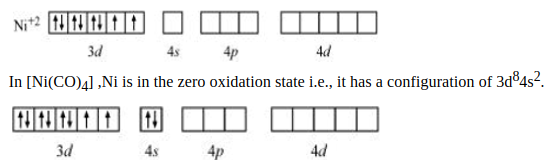
$[NIC14]^{2-}$ is paramagnetic while $[Ni(CO)_4]$ is diamagnetic though both are tetrahedral. Why?
Generate a complete, print-ready paper with questions like this in minutes — across 16+ boards, with answer keys.
|
|
Column I (Property)
|
|
Column II (Element)
|
|
(i)
|
Lanthanoid which shows $+4$ oxidation state
|
$(a)$
|
$Pm$
|
|
(ii)
|
Lanthanoid which can show $+2$ oxidation state
|
$(b)$
|
$Ce$
|
|
(iii)
|
Radioactive lanthanoid
|
$(c)$
|
$Lu$
|
|
(iv)
|
Lanthanoid which has $4f^7$ electronic configuration in +3 oxidation state
|
$(d)$
|
$Eu$
|
|
(v)
|
Lanthanoid which has $4f^{14}$ electronic configuration in +3 oxidation state
|
$(e)$
|
$Gd$
|
|
|
|
$(f)$
|
$Dy$
|
|
|
Column I (Coordination Compound)
|
|
Column II (Central metal atom)
|
|
a.
|
Chlorophyll
|
1.
|
Rhodium
|
|
b.
|
Blood pigment
|
2.
|
Cobalt
|
|
c.
|
Wilkinson catalyst
|
3.
|
Calcium
|
|
d.
|
Vitamin $B_{12}$
|
4.
|
Iron
|
|
|
|
5.
|
Magnesium
|
| Column I | Column II | ||
| (i) | Butter. | (a) | Dispersion of liquid in liquid. |
| (ii) | Pumice stone. | (b) | Dispersion of solid in liquid. |
| (iii) | Milk. | (c) | Dispersion of gas in solid. |
| (iv) | Paints. | (d) | Dispersion of liquid in solid. |