Question
[NIC14]2- is paramagnetic while [Ni(CO)4] is diamagnetic though both are tetrahedral. Why?
Answer

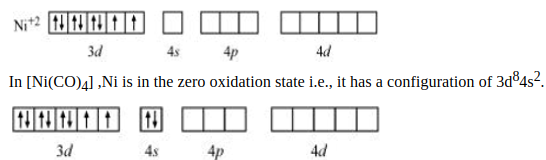
Though both $\left[ NICl _4\right]^{2-}$ and $\left[ Ni ( CO )_4\right]$ are tetrahedral, their magnetic characters are different. This is due to a difference in the nature of ligands. $CN ^{-}$is a weak field ligand and it does not cause the pairing of unpaired 3d electrons. Hence, $\left[ NICl _4\right]^{2-}$ is paramagnetic.
Image
But CO is a strong field ligand. Therefore, it causes the pairing of unpaired 3d electrons. Also, it causes the 4s electrons to shift to the 3d orbital, thereby giving rise to sp³hybridization. Since no unpaired electrons are present in this case, [Ni(CO)4] is diamagnetic.

Need a full question paper?

Generate a complete, print-ready paper with questions like this in minutes — across 16+ boards, with answer keys.

Start Generating Free

Similar questions

The decomposition of a hydrocarbon follows the equation.

$\text{k}=(4.5\times10^{11}\text{s}^{-1})\text{e}^{-28000}\text{ K/T}$

Calculate Ea.

Draw the structures of optical isomers of:
i. $\left[ Cr \left( C _2 O _4\right)_3\right]^{3-}$
ii. $\left[ PtCl _2( en )_2\right]^{2+}$
iii. $\left[ Cr \left( NH _3\right)_2 Cl _2( en )\right]^{+}$
Calculate the mass of a non-volatile solute (molar mass $40$ $g$ $mol ^{-1}$) which should be dissolved in 114 g octane to reduce its vapour pressure to 80%.
Using crystal field theory, draw energy level diagram, write the electronic configuration of the central metal atom/ion and determine the magnetic moment value in the following:
i. $\left[ CoF _6\right]^{3-},\left[ Co \left( H _2 O \right)_6\right]^{2+},\left[ Co ( CN )_6\right]^{3-}$
ii. $\left[ FeF _6\right]^{3-},\left[ Fe \left( H _2 O \right)_6\right]^{2+},\left[ Fe ( CN )_6\right]^{4-}$
A solution containing 30 g of non-volatile solute exactly in 90 g of water has a vapour pressure of 2.8 kPa at 298 K. Further, 18 g of water is then added to the solution and the new vapour pressure becomes 2.9 kPa at 298 K. Calculate :
(i) molar mass of the solute
(ii) vapour pressure of water at 298 K
Answer the following question:
g of benzoic acid (C6H5COOH) dissolved in 25g of benzene shows a depression in freezing point equal to 1.62K. Molal depression constant for benzene is 4.9K kg mol-1. What is the percentage association of acid if it forms dimer in solution?
Explain the stability of the highest oxidation states of the 3d series.
Describe the reactions of -COOH group present in carboxylic acids.
Match the items given in Column I with the type of solutions given in Column II.
 
Column I
 
Column II
i.
Soda water
a.
A solution of gas in solid.
ii.
Sugar solution
b.
A solution of gas in gas.
iii.
German silver
c.
A solution of solid in liquid.
iv.
Air
d.
A solution of solid in solid.
v.
Hydrogen gas in palladium
e.
A solution of gas in liquid.
 
 
f.
A solution of liquid in solid.
Describe the preparation of potassium permanganate. How does the acidified permanganate solution react with (i) iron(II) ions (ii) SO2 and (iii) oxalic acid? Write the ionic equations for the reactions.