Question
Nitric oxide, NO, reacts with oxygen to produce nitrogen dioxide.
$\text{2NO(g)+O}_2(\text{g)}\rightarrow\text{2NO}_2\text{(g)}$
The rate law for this reaction is:
$\text{Rate = k}[\text{NO]}^2[\text{O]}_2$
Propose a machanism for the reaction.
Answer

The probable proposed mechanism may be, $\text{NO+O}_2\rightarrow \text{NO}_3 \text{ (fast)}\ \dots\text{Step I}\\ $ $\text{NO}_3+ \text{NO }\rightarrow\text{NO}_2+\text{NO}_2 \text{ (slow)}\ \dots\text{Step II}{}$Since slowest reaction is the rate determining step, therefore
$\text{Rate = k}_1[\text{NO}_3]\text{ [NO]}$ $\text{k}=\frac{\text{|NO}_3|}{|\text{NO| |O}_2|}$ $[\text{NO}_3]=\text{k[NO] [O}_2]$ $\text{Rate = k}_1\text{K[NO] [O}_2]\text{ [NO]}=\text{k[NO]}^2[\text{O}_2]$, where $K =k_1.K$

Need a full question paper?

Generate a complete, print-ready paper with questions like this in minutes — across 16+ boards, with answer keys.

Start Generating Free

Similar questions

Write the names and structures of the monomers of the following polymers :
  1. Neoprene
  2. Buna$-N$
  3. PHBV
What type of colloidal sols are formed in the following:
  1. Sulphur vapours are passed through cold water.
  2. White of an egg is mixed with water.
  3. Soap solution.
After watching a programee on TV about the adverse effects of junk food and soft drink on the health of school children, Sonali, a student of class XII, discussed the issue with the school principal. Principal immediately instructed the canteen contractor to replace the fast food with the fibre and vitamins rich food like sprouts, salad, fruits etc. This decision was welcomed by the parents and the students.
After reading the above passage, answer the following questions:
  1. What values are expressed by Sonali and the principal of the school?
  2. Give two examples of water-soluble vitamins.
  1. ​​​​What is the role of activated charcoal in gas mask?
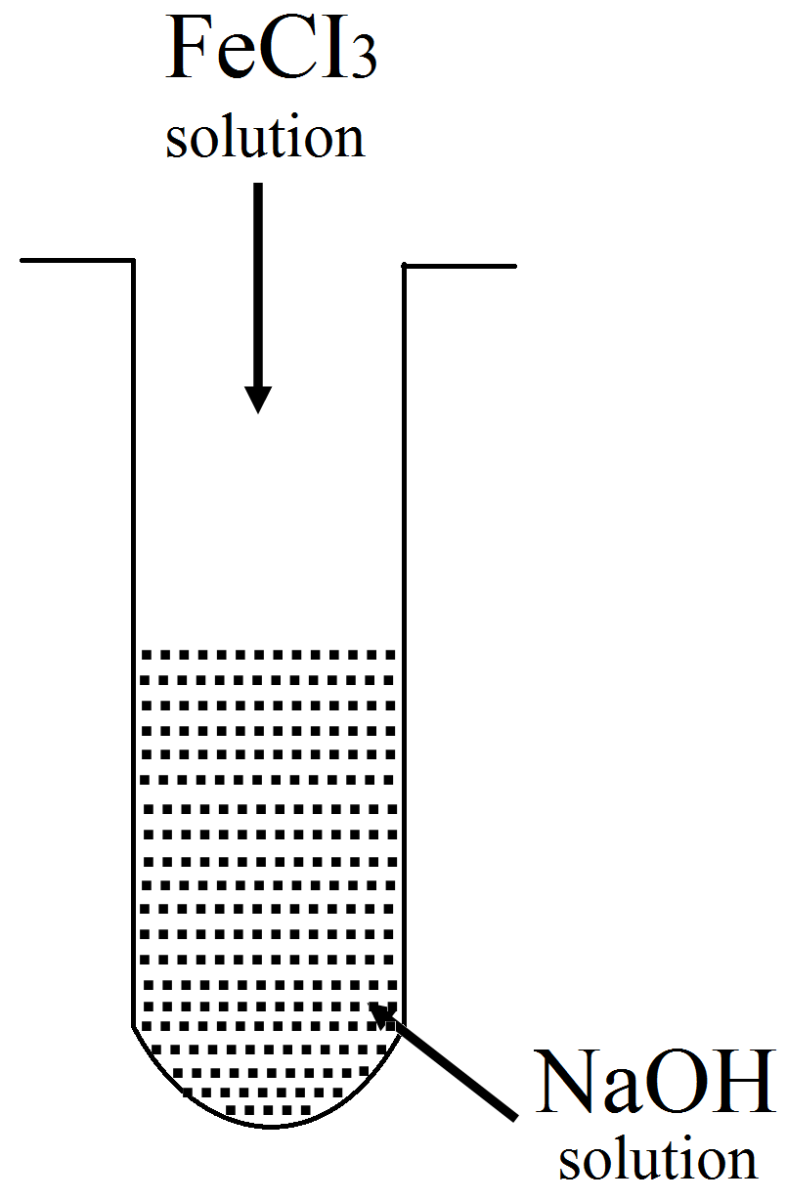
  2. A colloidal sol is prepared by the given method in figure. What is the charge on hydrated ferric oxide colloidal particles formed in the test tube? How is the sol represented?
  1. How does chemisorption vary with temperature?

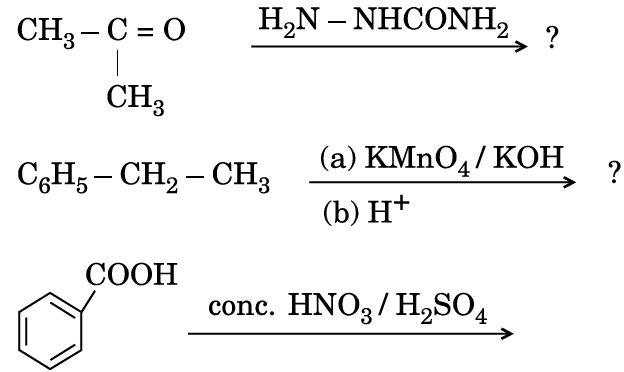
Predict the products of the following reactions:
Explain Van't Hoff factor.
The rate constant for the first order decomposition of $H_2O_2$ is given by the following equation:$\log{k}=14.2-\frac{\text{1.0}\times\text{10}^{4}}{\text{T}}K$
Calculate $E_a$ for this reaction and rate constant k if its half-life period be 200 minutes.
(Given: $R = 8.314 J K^{–1} mol^{–1}$)
An element $‘X’ ($At. mass $= 40g\ mol^{-1})$ having f.c.c. structure, has unit cell edge length of $400$pm. Calculate the density of $‘X’$ and the number of unit cells in $4$g of $‘X’ (N_A = 6.022 \times 10^{23}\ mol^{-1}).$
Complete the following chemical reaction equations:
$\text{MnO}^-_4(\text{aq})+\text{C}_2\text{O}^{2-}_4(\text{aq})+\text{H}^+(\text{aq})\xrightarrow{\ \ \ \ \ \ \ \ \ }$
In corundum, oxide ions are arranged in hexagonal close packing and aluminium ions occupy two-third of the octahedral voids. What is the formula of corundum?