Question
Explain Van't Hoff factor.
Answer

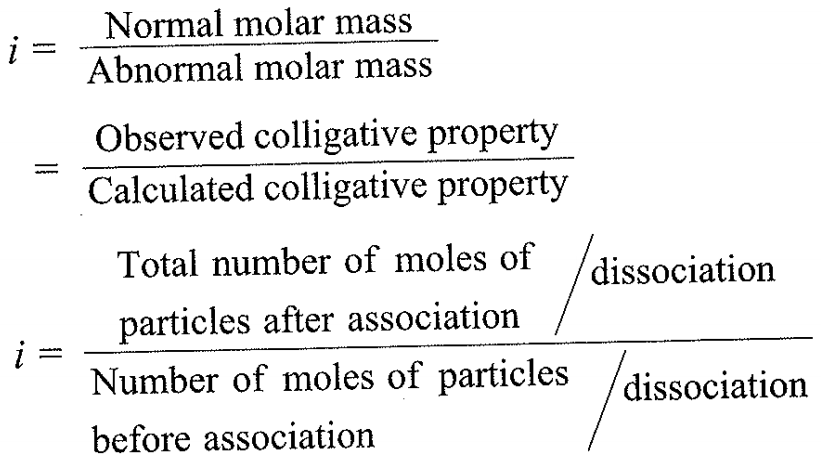
→ Van't Hoff introduced a factor i, known as the Van't Hoff factor, to account for the extent of dissociation or association. This factor i is defined as:
Image
→ Here abnormal molar mass is the experimentally determined molar mass and calculated colligative properties are obtained by assuming that the non-volatile solute is neither associated nor dissociated.
→ In case of association, value of i is less than unity while for dissociation it is greater than unity.
→ Inclusion of van't Hoff factor modifies the equations for colligative properties as follows:
→Relative lowering of vapour pressure of solvent,
$\frac{p_1^0-p_1}{p_1^0}= i \cdot \frac{n_2}{n_1}$
Elevation of Boiling point, $\Delta T_b=i K_b m$
Depression of Freezing point, $\Delta T_f=i K_f m$
Osmotic pressure of solution, $\pi=i n_2 R T / V$
→ $i$ for several strong electrolytes. For $KCI , NaCl$ and $MgSO _4, i$ values approach 2 as the solution becomes very dilute. As expected, the value of $i$ gets close to 3 for $K _2 SO _4$.
Salt* Values of i van't Hoff Factor
i for complete
dissociation of
solute
0.1 m0.01 m0.001 m
NaCl1.871.941.972.00
KCl1.851.941.982.00
$MgSO_{4}$1.211.531.822.00
$K_{2}SO_{4}$2.322.72.843.00

Need a full question paper?

Generate a complete, print-ready paper with questions like this in minutes — across 16+ boards, with answer keys.
Start Generating Free

Similar questions

What is Isotonic, hypertonic and hypotonic Solution?
Explain abnormal molar Tasses. Also explain association and dissociation of Solute.
Write a note on halide compounds of Transition elements.
One of the two figures given below represents substitution and the other represents elimination. Indicate which is substitution and which is elimination.
Image
The electrochemical cell given alongside converts the chemical energy released during the redox reaction
$\text{Zn(s) + Cu}^{2+}\text{(aq)}\xrightarrow{ \ \ \ \ \ \ \ }\text{Zn}^{2+}(\text{aq) + Cu(s)}$
to electrical energy. It gives an electrical potential of $1.1V$ when concentration $Zn^{2+}$ and $Cu^{2+}$ ions is unity. State the direction of flow of current and also specify whether zinc and copper are deposited or dissolved at their respective electrodes when:
  1. An external opposite potential of less than $1.1V$ is applied.
  2. An external potential of $1.1V$ is applied.
  3. An external potential of greater than $1.1V$ is applied.
An octahedral complex is prepared by mixing $\mathrm{CoCl}_3$ and $\mathrm{NH}_3$ in the molar ratio $1: 4,0.1 \mathrm{~m}$ solution of this complex was found to freeze at $0.372^{\circ} \mathrm{C}$. What is the formula of the complex? Given that molal depression constant ( Kf ) for water $=1.86^{\circ} \mathrm{C} / \mathrm{m}$.
An antifreeze solution is prepared from $222.6g$ of ethylene glycol $(C_2H_4(OH)_2)$ and $200$g of water. Calculate the molality of the solution. If the density of this solution be $1.072\ g\ mL^{-1},$ what will be the molarity of the solution?
Account for the following:
Bleaching of flowers by chlorine is permanent while that by sulphur dioxide is temporary.
An organic compound (A) has characteristic odour. On treatment with NaOH, it forms compounds (B) and (C). Compound (B) has molecular formula $C_7H_8O$ which on oxidation gives back (A). The compound (C) is a sodium salt of an acid. When (C) is treated with soda-lime, it yields an aromatic compound (D). Deduce the structures of (A), (B), (C) and (D). Write the sequence of reactions involved.
Conductivity of $0.00241 M$ acetic acid is $7.896 \times 10^{–5} S cm^{–1}$. Calculate its molar conductivity and if $\wedge^\circ_\text{m}$ for acetic acid is $390.5 S cm^2 mol^{–1}$, what is its dissociation constant?