MCQ
Nitrogen $(I)$ oxide is produced by
- AThermal decomposition of ammonium nitrate
- BDisproportionation of ${N_2}{O_4}$
- CThermal decomposition of ammonium nitrite
- ✓Interaction of hydroxyl amine and nitrous acid
Generate a complete, print-ready paper with questions like this in minutes — across 16+ boards, with answer keys.
$F_{2(g)} + 2e^- \rightarrow 2F^-_{(aq)}\, ;$ $E^o = + 2.85\, V$
$Cl_{2(g)} + 2e^- \rightarrow 2Cl^-_{(aq)}\, ;$ $E^o = + 1.36\, V$
$Br_{2(l)} + 2e^- \rightarrow 2Br^-_{(aq)}\, ;$ $E^o = + 1.06\, V$
$I_{2(s)} + 2e^- \rightarrow 2I^-_{(aq)}\, ;$ $E^o = + 0.53\, V$
The strongest oxidising and reducing agents respectively are
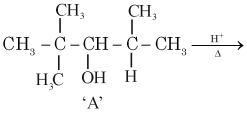
The total number of possible products formed by tertiary carbocation of $A$ is $.........$.