Question
No work is done by a force on an object if:
  1. The force is always perpendicular to its velocity.
  2. The force is always perpendicular to its acceleration.
  3. The object is stationary but the point of application of the force moves on the object.
  4. The object moves in such a way that the point of application of the force remains fixed.

Answer

  1. The force is always perpendicular to its velocity.
  1. The object is stationary but the point of application of the force moves on the object.
  2. The object moves in such a way that the point of application of the force remains fixed.

Explanation:

No work is done by a force on an object if the force is always perpendicular to its velocity. Acceleration does not always provide the direction of motion, so we cannot say that no work is done by a force on an object if it is always perpendicular to the acceleration. Work done is zero when the displacement is zero.

In a circular motion, force provides the centripetal acceleration. The angle between this force and the displacement is 90°, so work done by the force on an object is zero.

Need a full question paper?

Generate a complete, print-ready paper with questions like this in minutes — across 16+ boards, with answer keys.

Start Generating Free

Similar questions

Light of wavelength l = 5000 Å falls normally on a narrow slit. A screen placed at a distance of 1 m from the slit and perpendicular to the direction of light. The first minima of the diffraction pattern is situated at 5 mm from the centre of central maximum. The width of the slit is

(a) 0.1 mm

(b) 1.0 mm

(c) 0.5 mm

(d) 0.2 mm

A coil of N turns and mean cross-sectional area A is rotating with uniform angular velocity w about an axis at right angle to uniform magnetic field B. The induced e.m.f. E in the coil will be

(a) NBA sinwt

(b) NB w sinwt

(c) NB/A sinwt

(d) NBA w sinwt

The charge on a hole is equal to the charge of

(a) Zero

(b) Proton

(c) Neutron

(d) Electron

Which one of them is a radioisotope?

The capacity of a spherical conductor in MKS system is

(a)    

(b)

(c)  

(d)  

A long solenoid has n turns per meter and current I A is flowing through it. The magnetic field at the ends of the solenoid is

(a)   

(b)  

(c) Zero  

(d) 2 

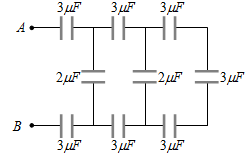
The resultant capacitance  between A  and B  in the following figure is equal to

(a) 1 μF

(b) 3 μF

(c) 2 μF

(d) 1.5 μF

Two statements are given-one labelled Assertion (A) and the other labelled Reason (R). Select the correct answer to these questions from the codes (a), (b), (c) and (d) as given below.
Assertion (A): Magnetic moment is measured in joule/ tesla or amp m2. Reason (R): Joule/ tesla is equivalent to amp m2.
For which frequency of light, the human eye is most sensitive?
A metal sheet is placed in front of a strong magnetic pole. A force needed to:
  1. Hold the sheet there if the metal is magnetic.
  2. Hold the sheed there if the metal is nonmagnetic.
  3. Move the sheet away from the pole with uniform velocity if the metal is magnetic.
  4. Move the sheet away from the pole with uniform velocity if the metal is nonmagnetic. Negative any effect if oaramagnetism, diamagnetism and gravity.