MCQ
No work is done by a force on an object if:
  • A
    The object is stationary but the point of application of the force moves on the object.
  • B
    The object moves in such a way that the point of application of the force remains fixed.
  • C
    The force is always perpendicular to its velocity.
  • D
    The force is always perpendicular to its acceleration.

Answer

  1. The object is stationary but the point of application of the force moves on the object.
  2. The object moves in such a way that the point of application of the force remains fixed.
  3. he force is always perpendicular to its acceleration.

Explanation:

 $\text{W}=\text{Fs}=\cos\theta=0$, when either s = 0 or $\theta=90^\circ$ i.e., when object is stationary but the point of application of the force moves on the object or object moves in such a way that point of application of force remains fixed; or force is at 90° to the acceleration.

Need a full question paper?

Generate a complete, print-ready paper with questions like this in minutes — across 16+ boards, with answer keys.

Start Generating Free

Similar questions

The horizontal range and the maximum height of a projectile are equal . The angle of projection of the projectile is
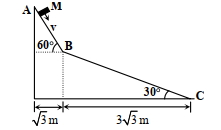
A small block of mass $M$ moves on a frictionless surface of an inclined plane, as shown in figure. The angle of the incline suddenly changes from $60^{\circ}$ to $30^{\circ}$ at point $\mathrm{B}$. The block is initially at rest at $A$. Assume that collisions between the block and the incline are totally inelastic $\left(\mathrm{g}=10 \mathrm{~m} / \mathrm{s}^2\right)$.

Figure: $Image$

$1.$ The speed of the block at point $B$ immediately after it strikes the second incline is

$(A)$ $\sqrt{60} \mathrm{~m} / \mathrm{s}$ $(B)$ $\sqrt{45} \mathrm{~m} / \mathrm{s}$

$(C)$ $\sqrt{30} \mathrm{~m} / \mathrm{s}$ $(D)$ $\sqrt{15} \mathrm{~m} / \mathrm{s}$

$2.$ The speed of the block at point $\mathrm{C}$, immediately before it leaves the second incline is

$(A)$ $\sqrt{120} \mathrm{~m} / \mathrm{s}$ $(B)$ $\sqrt{105} \mathrm{~m} / \mathrm{s}$

$(C)$ $\sqrt{90} \mathrm{~m} / \mathrm{s}$ $(D)$ $\sqrt{75} \mathrm{~m} / \mathrm{s}$

$3.$ If collision between the block and the incline is completely elastic, then the vertical (upward) component of the velocity of the block at point $B$, immediately after it strikes the second incline is

$(A)$ $\sqrt{30} \mathrm{~m} / \mathrm{s}$ $(B)$ $\sqrt{15} \mathrm{~m} / \mathrm{s}$

$(C)$ 0 $(D)$ $-\sqrt{15} \mathrm{~m} / \mathrm{s}$

Give the answer question $1,2$ and $3.$
Air is filled in a bottle at atmospheric pressure and it is corked at $35°C.$ If the cork can come out at $3$ atmospheric pressure than upto what temperature should the bottle be heated in order to remove the cork ...... $^oC$
$Assertion$ : When percentage errors in the measurement of mass and velocity are $1\%$ and $2\%$ respectively, the percentage error in $K.E.$ is $5\%$.

$Reason$ : $\frac{{\Delta E}}{E} = \frac{{\Delta m}}{m} + \frac{{2\Delta v}}{v}$

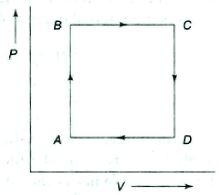
A thermodynamic process is the pressure and volumes corresponding to some points in the figure are, $P_A = 3 \times 10^4 Pa$, $V_A = 2 \times 10^{-3}\, m^3$, $P_B = 8 \times 10^4 Pa$, $V_D = 5 \times 10^{-3}\,m^3$. In process $AB, 600\, J$ of heat and in process $BC, 200\, J$ of heat is added to the system. The change in the internal energy in process $AC$ would be  .... $J$
Two balls in free space are colliding with each other. Which of the following statement regarding linear momentum conservation of the system is true ?
A stone is shot straight upward with a speed of $20\, m/sec$ from a tower $200\, m$ high. The speed with which it strikes the ground is approximately........$m/sec$
An astronaut of mass $m$ is working on a satellite or biting the earth at a distance $h$ from the earth's surface. The radius of the earth is $R$, while its mass is $M$. The gravitational pull $F_G$ on the astronaut is
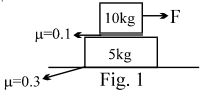
The acceleration of $10\, kg$ block when $F = 30\,N$ ........ $m/s^2$
A scooter of $40\,kg$ mass moving with velocity $4\,m/s$ collides with another scooter of $60\,kg$ mass and moving with velocity $2\,m/s.$ After collision the two scooters stick to each other the loss in kinetic energy .............. $\mathrm{J}$