MCQ
Nuclear binding energy is equivalent to
  • A
    Mass of proton
  • B
    Mass of neutron
  • C
    Mass of nucleus
  • Mass defect of nucleus

Answer

Correct option: D.
Mass defect of nucleus
d
$B.E.$ = $\Delta \,m\,amu =\Delta  m \times 931\, MeV.$

Need a full question paper?

Generate a complete, print-ready paper with questions like this in minutes — across 16+ boards, with answer keys.

Start Generating Free

Similar questions

A particle of mass $m$ with an initial velocity $u\hat i$ collides perfectly elastically with a mass $3m$ at rest. It moves with a velocity $v\hat j$ after collision, then, $v$ is given by
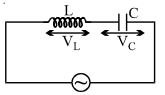
The current $I$, potential difference $V_L$ across the inductor and potential difference $V_C$ across the capacitor in circuit as shown in the figure are best represented vectorially as
For a domestic AC supply of $220 \,V$ at $50 \,cps$, the potential difference between the terminals of a two-pin electric outlet in a room is (in volt) given by
An electron has a mass of $9.1 \times {10^{ - 31}}kg$. It revolves round the nucleus in a circular orbit of radius $0.529 \times {10^{ - 10}}metre$ at a speed of $2.2 \times {10^6}m/s$. The magnitude of its linear momentum in this motion is
Energy of $1\,g$ uranium is equal to
A body takes $1\frac{1}{3}$ times as much time to slide down a rough identical but smooth inclined plane. If the angle of inclined plane is $45^o$, the coefficient of friction is
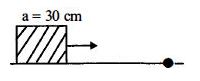
A cubical block of side $30\,cm$  is moving with  velocity $2\,\,ms^{-1}$ on a smooth horizontal surface. The surface has a bump at a point $O$ as shown in figure. The angular velocity (in rad/s) of the block immediately after it hits the bump, is
The de-Broglie wavelength of the electron in the ground state of a hydrogen atom is........$\mathop A\limits^o$
Thermal neutrons can cause fission in
The objective and the eyepiece of a microscope have focal lengths of $4\, mm$ and $25\, mm$, respectively. The objective produces a real image $30$ times the size of the object.  The final image is viewed at infinity. The near point of the microscope user is at  $25 \,cm.$ The overall magnification of the microscope is