A body takes $1\frac{1}{3}$ times as much time to slide down a rough identical but smooth inclined plane. If the angle of inclined plane is $45^o$, the coefficient of friction is
Medium


Download our appand get started for free
Experience the future of education. Simply download our apps or reach out to us for more information. Let's shape the future of learning together!No signup needed.*
Similar Questions
- 1A particle of mass $m$ is executing uniform circular motion on a path of radius $r$. If $p$ is the magnitude of its linear momentum. The radial force acting on the particle isView Solution
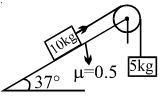
- 2The blocks are in equilibrium. The friction force acting on $10 kg$ block is :View Solution
- 3View SolutionA box is placed on an inclined plane and has to be pushed down. The angle of inclination is
- 4A $2 \,kg$ mass starts from rest on an inclined smooth surface with inclination $30^°$ and length $2\, m$. ...... $m$ will it travel before coming to rest on a frictional surface with frictional coefficient of $0.25$View Solution
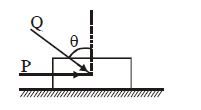
- 5A block of mass $m$ lying on a rough horizontal plane is acted upon by a horizontal force $P$ and another force $Q$ inclined an at an angle $\theta $ to the vertical. The minimum value of coefficient of friction between the block and the surface for which the block will remain in equilibrium isView Solution
- 6A child weighing $25$ kg slides down a rope hanging from the branch of a tall tree. If the force of friction acting against him is $2\, N$, ........ $m/s^2$ is the acceleration of the child (Take $g = 9.8\,m/{s^2})$View Solution
- 7The coefficient of friction between a body and the surface of an inclined plane at $45^°$ is $0.5.$ If $g = 9.8\,m/{s^2}$, the acceleration of the body downwards in $m/{s^2}$ isView Solution
- 8A ball of mass $0.1\, Kg$. is whirled in a horizontal circle of radius $1\, m$. by means of a string at an initial speed of $10\, R.P.M.$ Keeping the radius constant, the tension in the string is reduced to one quarter of its initial value. The new speed is ....... $r.p.m.$View Solution
- 9View SolutionThe limiting friction between two bodies in contact is independent of
- 10A string breaks if its tension exceeds $10$ newtons. A stone of mass $250\, gm$ tied to this string of length $10 \,cm$ is rotated in a horizontal circle. The maximum angular velocity of rotation can be .......... $rad/s$View Solution