Question
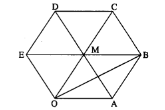
OABCDE is a regular hexagon. The points $A$ and $B$ have position vectors $\bar{a}$ and $\bar{b}$

respectively, referred to the origin $\mathrm{O}$. Find, in terms of $\bar{a}$ and $\bar{b}$ the position vectors of $\mathrm{C}, \mathrm{D}$

and E.

Answer


Image

Given: $\overline{\mathrm{OA}}=\bar{a}_r \overline{\mathrm{OB}}=\bar{a}$ Let $\mathrm{AD}, \mathrm{BE}, \mathrm{OC}$ meet at $\mathrm{M}$.

Then M bisects AD, BE, OC.

$\overline{\mathrm{AB}}=\overline{\mathrm{AO}}+\overline{\mathrm{OB}}=-\overline{\mathrm{OA}}+\overline{\mathrm{OB}}=-\bar{a}+\bar{b}=\bar{b}-\bar{a}$

∵ OABM is a parallelogram

$\begin{aligned} & \therefore \overline{\mathrm{OM}}=\overline{\mathrm{AB}}=\bar{b}-\bar{a} \\ & \overline{\mathrm{OC}}=2 \overline{\mathrm{OM}}=2(\bar{b}-\bar{a})=2 \bar{b}-2 \bar{a}\end{aligned}$

$\begin{aligned} \overline{\mathrm{OD}} & =\overline{\mathrm{OC}}+\overline{\mathrm{CD}} \\ & =\overline{\mathrm{OC}}-\overline{\mathrm{DC}}\end{aligned}$

$\begin{aligned} & =\overline{\mathrm{OC}}-\overline{\mathrm{OA}} \quad \ldots[\because \mathrm{OA}=\mathrm{DC} \text { and } \mathrm{OA} \| \mathrm{DC}] \\ & =2 \bar{b}-2 \bar{a}-\bar{a} \\ & =2 \bar{b}-3 \bar{a}\end{aligned}$

$\begin{aligned} \overline{\mathrm{OE}} & =\overline{\mathrm{OM}}+\overline{\mathrm{ME}} \\ & =(\bar{b}-\bar{a})-\overline{\mathrm{EM}}\end{aligned}$

$\begin{aligned} & =\bar{b}-\bar{a}-\bar{a} \quad \ldots[\because \mathrm{EM}=\mathrm{OA} \text { and } \mathrm{EM} \| \mathrm{OA}] \\ & =\bar{b}-2 \bar{a}\end{aligned}$

$\begin{aligned} & =\bar{b}-\bar{a}-\bar{a} \quad \ldots[\because \mathrm{EM}=\mathrm{OA} \text { and } \mathrm{EM} \| \mathrm{OA}] \\ & =\bar{b}-2 \bar{a}\end{aligned}$

Hence, the position vectors of $\mathrm{C}, \mathrm{D}$ and $\mathrm{E}$ are $2 \bar{b}-2 \bar{a}_t 2 \bar{b}-3 \bar{a}$ and $\bar{b}-2 \bar{a}$ respectively.

Need a full question paper?

Generate a complete, print-ready paper with questions like this in minutes — across 16+ boards, with answer keys.

Start Generating Free

Similar questions

Evaluate the following:
$\int_{-1}^1 \frac{1+x^3}{9-x^2} d x$
Evaluate the following:

$\int x^2 \cos ^{-1} x d x$

Find the inverse of $A=\left[\begin{array}{lll}1 & 0 & 1 \\ 0 & 2 & 3 \\ 1 & 2 & 1\end{array}\right]$ by elementary column transformations.
Differentiate the following w.r.t. x:

$\sqrt[3]{\frac{4 x-1}{(2 x+3)(5-2 x)^2}}$

Suppose the error involved in making a certain measurement is a continuous r.v. X with p.d.f.
$f(x) = k(4 – x^2), -2 \leq x \leq 2$ and $= 0$ otherwise.
Compute
$P(X < -0.5$ or $X > 0.5)$
If $y=f(x)$ is a differentiable function of $x$ such that inverse function $x=f^{-1}(y)$ exists, then prove that $x$ is a differentlable function of $y$ and $\frac{d x}{d y}=\frac{1}{\frac{d y}{d x}}$ where $\frac{d y}{d x} \neq 0$. Hence find $\frac{d}{d x}\left(\tan ^{-1} x\right)$
If $y=f(u)$ is a differentiable function of $u$ and $u=g(x)$ is a differentiable function of $x$ such that the composite function $y=f[g(x)]$ is a differentlable function of $x$ then prove that
$\frac{d y}{d x}=\frac{d y}{d u} \times \frac{d u}{d x}$
Hence find $\frac{d y}{d x}$ if $y=\sqrt{x^2+5}$
$\int \frac{5 e ^x}{\left( e ^x+1\right)\left( e ^{2 x}+9\right)} d x$
Show that
$\tan ^{-1}\left(\frac{\sqrt{1+x}-\sqrt{1-x}}{\sqrt{1+x}+\sqrt{1-x}}\right)=\frac{\pi}{4}-\frac{1}{2} \cos ^{-1} x$
for $-\frac{1}{\sqrt{2}} \leqslant x \leqslant 1$
Find the inverse of the following matrices by the adjoint method : $\left[\begin{array}{ccc}1 & 0 & 0 \\ 3 & 3 & 0 \\ 5 & 2 & -1\end{array}\right]$