Answer

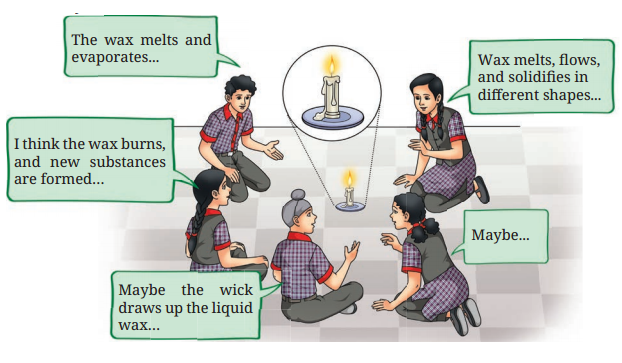
Conclusion: Burning of a candle involves both physical and chemical change. Melting of wax, evaporation of wax to wax vapour and solidification of melted wax to solid wax are all physical changes. While burning of wax to produce new substance, carbon dioxide is a chemical change.

Need a full question paper?

Generate a complete, print-ready paper with questions like this in minutes — across 16+ boards, with answer keys.
Start Generating Free

Similar questions

What type of mirror is used as a side mirror in a scooter? Why is this type of mirror chosen?
You were blindfolded and asked to identify the drinks provided in two different glasses. You could identify drink A as lime juice and B as bitter gourd juice. How could you do it inspite of being blindfolded?
Sahil says that stomach acid is harmful. Do you agree or disagree? Justify.
An electrician is carrying out some repairs in your house. He wants to replace a fuse by a piece of wire. Would you agree? Give reasons for your response.
How does neutralisation help in industrial waste treatment?
Look at the given reaction.
Hydrochloric acid + Sodium hydroxide (base) → Sodium chloride (salt) + Water
Sodium chloride formed in this reaction remains in solution form. Can we get solid sodium chloride from this solution? Suggest a method (if any).
A group chat among students becomes a platform for sharing jokes and images at someone's expense. One student notices it but chooses not to intervene. How should the situation be addressed, and what are the responsibilities of individuals when using digital platforms during adolescence?
The water bearing layer of the earth called $P$ is made up of two components $O$ and $R$, in which $R$ water collect under the ground. The top level of layer Pis called $S$. When too many tubewells are used in an area, the level of $S$ in that area goes down. What are $P, Q, R$ and $S$?
Why are metals like copper used for making electric wires?
Which property of a conducting wire is utilised in making electric fuse?