Questions

2 Marks Questions

🎯

Test yourself on this topic

44 questions · timed · auto-graded

Question 12 Marks
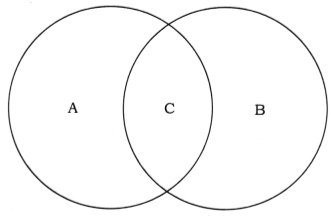
Some changes are given here. Write physical changes in the area marked ‘A’ and chemical changes in the area marked ‘B’. Enter the changes which are both physical and chemical in the area marked ‘C
Process of burning a candle; Tearing of paper; Rusting; Curdling of milk; Ripening of fruits; Melting of ice; Folding of clothes; Burning of magnesium and Mixing baking soda with vinegar.
Image
View full question & answer
Question 22 Marks
Natural factors, such as wind, rain, etc., help in the formation of soil from rocks. Is this change physical or chemical and why?
Answer
The formation of soil from rocks involves both physical and chemical changes. Natural factors like wind, rain and temperature break down rocks into smaller pieces (physical change), while chemical processes, like weathering, also change the minerals in the rocks (chemical change). Both types of changes work together to form soil.
View full question & answer
Question 32 Marks
Are the changes of water to ice and water to steam, physical or chemical? Explain
Answer
Both, the change of water to ice and water to steam are physical changes. In both processes, the chemical composition of water remains the same; only its state changes from liquid to solid (ice) or from liquid to gas (steam). No new substance is formed which is a characteristic of physical changes.
View full question & answer
Question 42 Marks
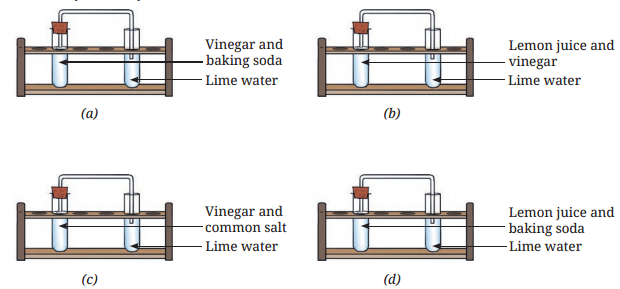
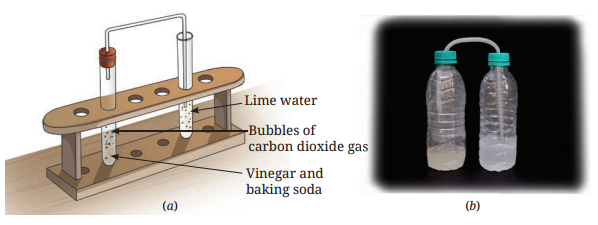
The experiments shown in Fig. a, b, c, and d were performed. Find out in which case(s) did lime water turn milky and why?
Image
Answer
In Figure (a), when vinegar reacts with baking soda, carbon dioxide gas is released. This carbon dioxide gas travels through the straw into the test tube with lime water, where it reacts to form calcium carbonate, a white solid substance that makes the lime water appear milky.
${\text { Carbon dioxide }} +\underset{\text {(Calcium hydroxide) }}{\text {Lime water }} \rightarrow \underset{\text { (White insoluble substance) }}{\text { Calcium carbonate }} + {\text { Water}}$
View full question & answer
Question 52 Marks
Most of the physical changes are reversible. Give some examples with reasons.
Answer
Melting of ice into water is a reversible physical change because water can be frozen back into ice.
Inflating and deflating a balloon is also reversible because no new substance is formed.
View full question & answer
Question 62 Marks
Define combustion. What are the prerequisite conditions for the combustion reaction to occur.
Answer
Combustion is a chemical process in which a substance reacts with oxygen to produce heat and usually light.
The prerequisite conditions for combustion to occur are the presence of a combustible substance, sufficient supply of oxygen, and a suitable ignition temperature.
View full question & answer
Question 72 Marks
Explain the process of weathering of rocks and how it involves both physical and chemical changes.
Answer
Weathering of rocks is the slow breaking down of rocks into smaller pieces by natural forces like wind, water, and temperature changes.
It involves physical changes when rocks break into smaller pieces and chemical changes when minerals in rocks react with air and water.
View full question & answer
Question 82 Marks
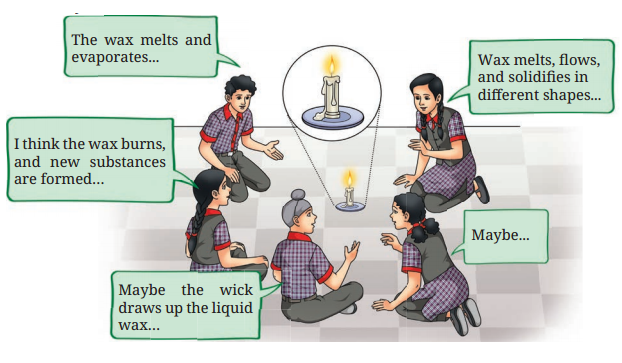
When a candle burns, both physical and chemical changes take place. Identify these changes. Give another example of a familiar process in which both the chemical and physical changes take place.
Answer
Melting of wax is a physical change and burning of wax is a chemical change when a candle burns.
Another example is burning of LPG gas, where gas burning is a chemical change and melting of solid impurities is a physical change.
View full question & answer
Question 92 Marks
Burning of crackers is a chemical change. Justify the given statement.
Answer
The burning of crackers is a chemical change because new substances are formed along with heat, light, and sound, and the change is irreversible.
View full question & answer
Question 102 Marks
Give two examples each of natural slow change and desirable change.
Answer
Two examples of natural slow changes are rusting of iron and growth of plants.
Two examples of desirable changes are cooking of food and setting of cement.
View full question & answer
Question 112 Marks
Setting of curd from milk is a chemical change. Explain.
Answer
Setting of curd from milk is a chemical change because new substances are formed and milk cannot be obtained again from curd.
View full question & answer
Question 122 Marks
Classify the changes involved in the following processes as physical or chemical changes:
(a) Photosynthesis
(b) Dissolving sugar in water
(c) Burning of coal
(d) Melting of wax
(e) Beating aluminium to make aluminium foil
(f) Digestion of food
Answer
(a) Photosynthesis is a chemical change because new substances like glucose and oxygen are formed.
(b) Dissolving sugar in water is a physical change because no new substance is formed and sugar can be recovered.
(c) Burning of coal is a chemical change because new substances like carbon dioxide and ash are produced.
(d) Melting of wax is a physical change because only the state of wax changes and no new substance is formed.
(e) Beating aluminium to make aluminium foil is a physical change because only the shape of aluminium changes.
(f) Digestion of food is a chemical change because food is converted into new substances.
View full question & answer
Question 132 Marks
Classify the following changes into physical change, chemical change, reversible change or irreversible change.
(i) Folding of paper to make a boat.
(ii) Cooking chapati from wheat flour.
Answer
(i) Folding of paper to make a boat is a physical and reversible change because only the shape of the paper changes and it can be unfolded back.
(ii) Cooking chapati from wheat flour is a chemical and irreversible change because new substances are formed and the original flour cannot be obtained again.
View full question & answer
Question 142 Marks
Explain why burning of wood and cutting it into small pieces are considered as two different types of changes.
Answer
Burning of wood is a chemical change because new substances like ash and gases are formed and it is irreversible.
Cutting wood into small pieces is a physical change because only the size changes and no new substance is formed.
View full question & answer
Question 152 Marks
Define the term ‘bioluminescence’. Give one example.
Answer
Bioluminescence is the ability of living organisms to produce light by a chemical reaction within their bodies.
An example of bioluminescence is the glow produced by fireflies.
View full question & answer
Question 162 Marks
Burning of candle involves both physical and chemical change. Justify this statement.
Answer
The burning of a candle involves both physical and chemical changes because the melting of wax is a physical change, while the burning of wax produces new substances like carbon dioxide and water vapour, which is a chemical change.
View full question & answer
Question 172 Marks
When baking soda is mixed with lemon juice, bubbles are formed with the evolution of a gas. What type of change is it? Explain
Answer
It is a chemical change because carbon dioxide gas is produced and new substances are formed.
View full question & answer
Question 182 Marks
Define ignition temperature.
Answer
Ignition temperature is the minimum temperature at which a substance starts burning in air.
View full question & answer
Question 192 Marks
Why lime water turns milky on passing carbon dioxide gas to it?
Answer
Lime water turns milky when carbon dioxide gas is passed through it because carbon dioxide reacts with lime water to form insoluble calcium carbonate, which makes the solution appear milky.
View full question & answer
Question 202 Marks
Making popcorns from corns is what type of change?
Answer
Making popcorns from corns is a chemical and irreversible change because new substances are formed and it cannot be reversed.
View full question & answer
Question 212 Marks
Give two examples of physical changes.
Answer
Two examples of physical changes are melting of ice and dissolving sugar in water.
View full question & answer
Question 222 Marks
What is rust?
Answer
Rust is a reddish-brown substance formed when iron reacts with oxygen and moisture in the air.
View full question & answer
Question 232 Marks
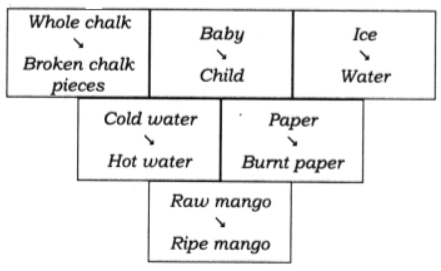
Select the chemical or physical changes which are reversible by putting reverse arrow in the following boxes:
Image
View full question & answer
Question 242 Marks
Write the characteristics of a chemical change.
Answer
Characteristics of a chemical change:
1. Mostly chemical reactions are irreversible.
2. They cause release or absorption of energy.
3. New substances with new properties are formed.
4. The properties of reactants are different from the products.
View full question & answer
Question 252 Marks
Explain the following:
(a) Lime water turns milky on passing carbon dioxide gas into it.
(b) Bubbles are produced when acetic acid is added to a solution of sodium hydrogen carbonate.
Answer
(a) On passing carbon dioxide gas through lime water, the lime water turns milky due to the formation of a white coloured insoluble calcium carbonate.
(b) Bubbles are produced when acetic acid is added to a solution of sodium hydrogen carbonate due to the formation of carbon dioxide gas.
View full question & answer
Question 262 Marks
Explain the activity of burning of magnesium ribbon. Represent the change by an equation.
Answer
Get a small and thin strip or ribbon of magnesium. Clean its tip with sand paper. Bring the tip near a candle flame. It burns with a brilliant white light. After combustion white powdery ash is left, it is called magnesium oxide.
View full question & answer
Question 272 Marks
What are physical changes?
Answer
The changes in which a substance undergoes a change in its physical properties are called physical changes.
Physical changes are generally reversible. In such changes, no new substances are formed. For example, melting of ice, formation of steam, etc.
View full question & answer
Question 282 Marks
Answer
Conclusion: Burning of a candle involves both physical and chemical change. Melting of wax, evaporation of wax to wax vapour and solidification of melted wax to solid wax are all physical changes. While burning of wax to produce new substance, carbon dioxide is a chemical change.
View full question & answer
Question 292 Marks
Answer
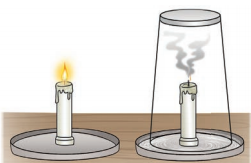
Observation and conclusion: In figure (a), candle keeps on burning as it is not covered and supply of air (oxygen) is available. But in figure (b), as candle is covered with a glass tumbler, does not get a continuous supply of air, so, it gets extinguished. This concludes oxygen is required for combustion.
View full question & answer
Question 302 Marks
Answer
Observation and conclusion: When we add a pinch of baking soda (sodium hydrogen carbonate) to vinegar or lemon juice, bubbles of carbon dioxide gas are produced with a fizzing sound. When we pass this gas to lime water, it turns milky. Thus, in this process, new substances are formed, it is a chemical change.
Vinegar + Baking soda $\rightarrow$ Carbon dioxide + Other substances
View full question & answer
Question 312 Marks
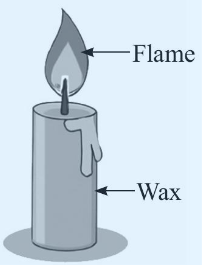
An image depicts a candle being lit. The wax of the candle is melting and evaporating to form a flame, with the wick burning and producing light and heat.
Image
(a) Explain the physical and chemical changes occurring when a candle burns. What happens to the wax, and what is produced during combustion?
(b) If you cover the candle with a glass jar, the flame will eventually go out. What causes this, and what does this tell you about the requirements for combustion?
Answer
self
View full question & answer
Question 322 Marks
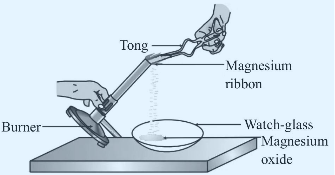
The image shows a piece of magnesium ribbon being burnt in the air.
Image

(a) Describe the changes that occur when magnesium is burnt in air. What type of change is involved, and what are the products formed?
(b) Explain the importance of such reactions in daily life. Where are these reactions used, and why are they significant?
Answer
self
View full question & answer
Question 332 Marks
How would you identify whether a change is physical or chemical during an experiment?
Answer
→ To distinguish between physical and chemical changes during an experiment, focus on the composition of the substance before and after the change.
→ If the substance remains the same chemically, only altering its appearance or state (like melting ice), it's a physical change. However, if a new substance with different properties is formed (such as burning wood and creating ash), it indicates a chemical change has occurred. Observing signs like gas production, color change, or heat release can also confirm a chemical change.
View full question & answer
Question 342 Marks
Can you think of a way to reverse the chemical changes that occur during cooking? Explain.
Answer
Generally, the chemical changes that occur during cooking are difficult to reverse.
Example: when you bake a cake, the ingredients undergo chemical reactions to form new substances with different properties. It is not possible to return the cake back to its original raw ingredients.
View full question & answer
Question 352 Marks
If you have a burning candle and you cover it with a glass, what happens to the flame? Explain using scientific reasoning.
Answer
When a burning candle is covered with a glass, the flame will eventually extinguish due to the consumption of oxygen.
Combustion requires oxygen to sustain the burning process. As the candle burns inside the closed glass, it uses up the available oxygen. Once the oxygen level drops below a critical point, the flame can no longer be supported, and the candle goes out. This demonstrates that oxygen is essential for combustion.
View full question & answer
Question 362 Marks
How would you prevent rusting in iron objects? Discuss with relevant chemical reactions.
Answer
To prevent rusting in iron objects, create a barrier between the iron, oxygen, and water.
This can be achieved through methods like painting, coating with oil or grease, or galvanizing (coating with zinc).
Example: galvanization works because zinc corrodes preferentially, protecting the iron.
Chemically, the main reaction for rusting is:
$4 Fe +3 O _2+6 H _2 O \rightarrow 4 Fe ( OH )_3$
View full question & answer
Question 372 Marks
How can changes in the environment affect natural processes like erosion and weathering?
Answer
Changes in the environment, such as temperature fluctuations and the presence of water or chemicals, can significantly impact natural processes like erosion and weathering. Temperature changes can cause rocks to break apart, while water and chemicals can react with rocks, leading to their decomposition. These processes contribute to the formation of soil and the shaping of landscapes over time.
View full question & answer
Question 382 Marks
Can a physical change have harmful effects? Explain with examples.
Answer
Yes, physical changes can have harmful effects.
Example: The increased consumption of fuels in cars and airplanes leads to a rise in carbon dioxide levels in the atmosphere, contributing to climate change. Similarly, the drying of paint on walls and furniture releases substances through evaporation, causing atmospheric pollution.
View full question & answer
Question 392 Marks
If you mix two substances, A and B, and they undergo a change to form a new substance, how can you confirm if it is a chemical change?
Answer
To confirm if a change is chemical, check for indicators like gas evolution, color change, heat production, or precipitate formation.
If mixing substances A and B results in a new substance with significantly different properties (like a new color, gas, or solid), and the change is not easily reversible, it indicates a chemical reaction. These signs suggest that new chemical bonds have formed.
View full question & answer
Question 402 Marks
What happens when you mix vinegar with baking soda? Explain the change.
Answer
→ Mixing vinegar and baking soda leads to a chemical change that produces new substances.
→ The reaction releases carbon dioxide gas, which you see as bubbles. Additionally, other new substances are formed, indicating that the original compounds have been transformed into something new.
View full question & answer
Question 412 Marks
How does the process of making curd from milk illustrate a chemical change?
Answer
The making of curd from milk exemplifies a chemical change because it involves the transformation of milk into a new substance with different properties. During curdling, bacteria convert lactose (milk sugar) into lactic acid, resulting in a change in taste, texture, and acidity. This conversion indicates a chemical reaction, making curd formation a chemical change.
View full question & answer
Question 422 Marks
What happens when a candle is burnt? Explain the physical and chemical changes involved.
Answer
Burning a candle involves both physical and chemical changes.
→ Physically, the wax melts (state change) due to the heat, and this melted wax can solidify again if cooled.
→ Chemically, the wax undergoes combustion, reacting with oxygen to produce carbon dioxide and water vapor (new substances), releasing heat and light. This combustion is irreversible.
View full question & answer
Question 432 Marks
How is rusting of iron a chemical change? Explain with an example.
Answer
Rusting of iron is a chemical change because it involves the formation of a new substance (rust) with different properties than the original iron.
View full question & answer
Question 442 Marks
What is a physical change? Give two examples.
Answer
A physical change alters the form or appearance of a substance but doesn't change it into a new substance.
Example:
(i) Melting ice
(ii) Chopping vegetables.
View full question & answer
2 Marks Questions - Science STD 7 Questions - Vidyadip