Question
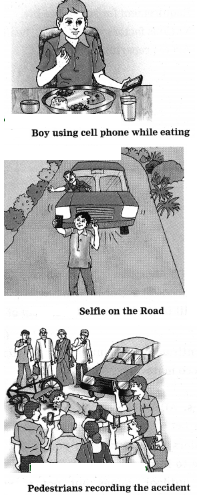
Observe the images below. Is it rational? Why?
Image

Answer

In the above three pictures three incidences are shown. In the first picture (Fig. 9.3), the boy who is taking his lunch is shown. He is busy with his mobile while having his food. In second picture (Fig. 9.4), a young man is taking selfie while standing in the busy road. He is not aware of the approaching car too. In the third picture (Fig. 9.5), some men are taking pictures of the accident that has recently happened. The person is injured and bleeding. But these men-are busy in photographing him.

All the three pictures are showing irrational and improper behaviour. We should respect the food while eating. We should eat in a disciplined way. Standing in the middle of the road and taking selfie is like inviting the mishap. Selfie taken in such circumstances usually results in an accident. In the last picture, the sensitivity and the humanity to save the victim is lacking. If the victim is immediately rushed to hospital, his life can be saved. Instead of helping the victim if people are engrossed in taking pictures, then it is absolutely wrong.

Need a full question paper?

Generate a complete, print-ready paper with questions like this in minutes — across 16+ boards, with answer keys.
Start Generating Free

Similar questions

Describe the human female reproductive system.
A filamentous alga X is found in ponds, lakes and slow-moving streams. The filament of this alga simply breaks into two (or more) pieces on maturing and each piece then grows to become a complete new alga.
  1. Name an alga which X is likely to be.
  2. What is the colour of X?
  3. What is the method of forming new algae by the breaking of parent alga known as?
  4. An Amoeba also breaks up to form two daughter Amoebae. What is the difference in the splitting of Amoeba and splitting of this alga as a method of reproduction?
  5. Name one marine animal which reproduces in the same way as alga X.
Mendeleev predicted the existence of certain elements not known at that time and named two of them as eka - aluminium, and eka - silicon.
  1. Name the element which has taken the place of $(i)$ eka - aluminium, and $(ii)$ eka - silicon.
  2. Mention the period/ periods of these elements in the modern periodic table.
  3. Write the group/ groups of these elements in the modern periodic table.
  4. Classify these elements as metals, non - metals or metalloids.
  5. How many valence electrons are present in the atoms of each of these elements$?​​​​​​$
What is the correct reason for blinking/flickering of stars? Explain it.
(a) The blasts in the stars.
(b) Absorption of star light by the atmosphere.
(c) Motion of the stars.
(d) Changing refractive index of gases in the atmosphere.
A food chain occurring in the sea which provides food for many people can be written as:
phytoplankton → zooplankton → X → Y
  1. Name one phytoplankton.
  2. Name two zooplanktons.
  3. What could be X?
  4. Name the organism which Y could be.
  5. Which organism in the above food chain is a (i) primary consumer, and (ii) tertiary consumer?
Write short notes: Sacred Groves.
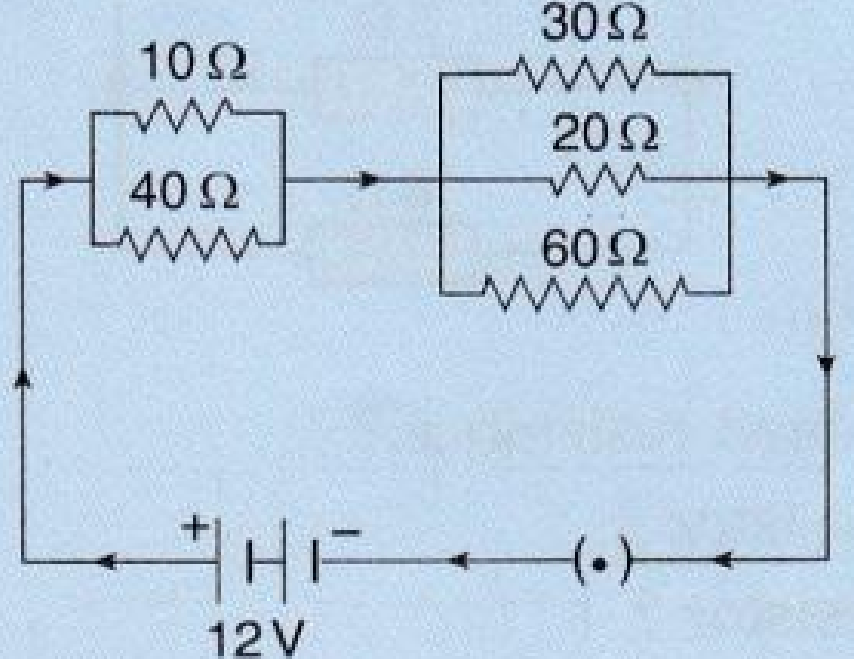
In the circuit diagram given below five resistances of $10 Ω, 40 Ω, 30 Ω, 20 Ω\ \text{and}\ 60 Ω$ are connected as shown to a $12V$ battery.

Calculate:
  1. Total resistance in the circuit.
  2. Total current flowing in the circuit.
Write short note :
Transition Elements.
Describe the human male reproductive system with the help of a neat labelled diagram.
What are symptoms of diseases like night blindness, rickets, beriberi, neuritis, pellagra, anaemia, scurvy?