Question
Obtain a relation for the distance travelled by an object moving with a uniform acceleration in the interval between 4th and 5th second.

Answer

Using the equation of motion $\text{s}=\text{ut}+\frac{1}{2}\text{at}^{2}$ Distance travelled in 5 seconds, $\text{s}=\text{u}\times5+\frac{1}{2}\text{a}\times5^{2}$ or $\text{s}=5\text{u}+\frac{25}{2}\text{a}$ Similary, distance travelled in 4seconds, $\text{s}=4\text{u}+\frac{16}{2}\text{a}$ Distance travelled in the interval between $4th$ and $5th$ seconds$=(\text{s-s'})=(\text{u}+\frac{9}{2}\text{a})\text{m}$

Need a full question paper?

Generate a complete, print-ready paper with questions like this in minutes — across 16+ boards, with answer keys.
Start Generating Free

Similar questions

How will you find the valency of chlorine, sulphur and magnesium?
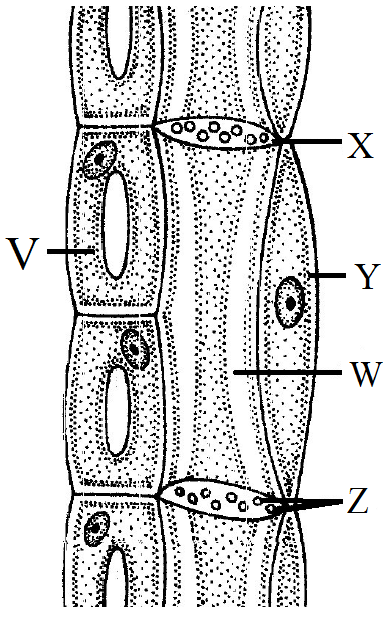
  1. Identify the figure. What is its function$?$
  2. Label $V$ and $W.$
  3. Label $X, Y$ and $Z.$
  4. W loses its nucleus in the mature state, still it remains alive. Explain how$?$
A ball of mass $200\ g$ falls from a height of $5$ metres. What is its kinetic energy when it just reaches the ground? $(8 = 9.8m/s).$
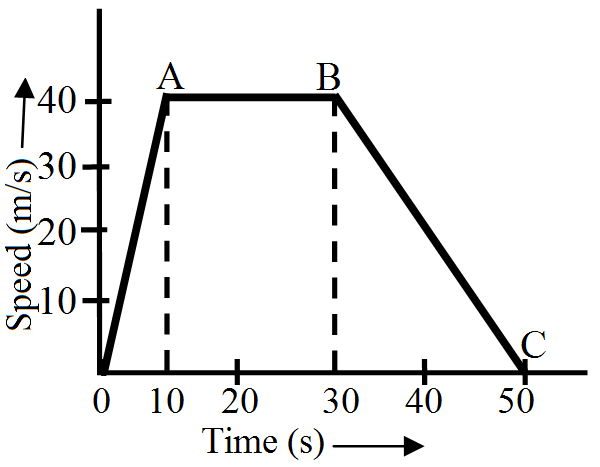
Study the speed-time graph of a car given alongside and answer the following questions:


  1. What type of motion is represented by OA?
  2. What type of motion is represented by AB?
  3. What type of motion is represented by BC?
  4. What is the acceleration of car from O to A?
  5. What is the acceleration of car from A to B?
  6. What is the retardation of car from B to C?
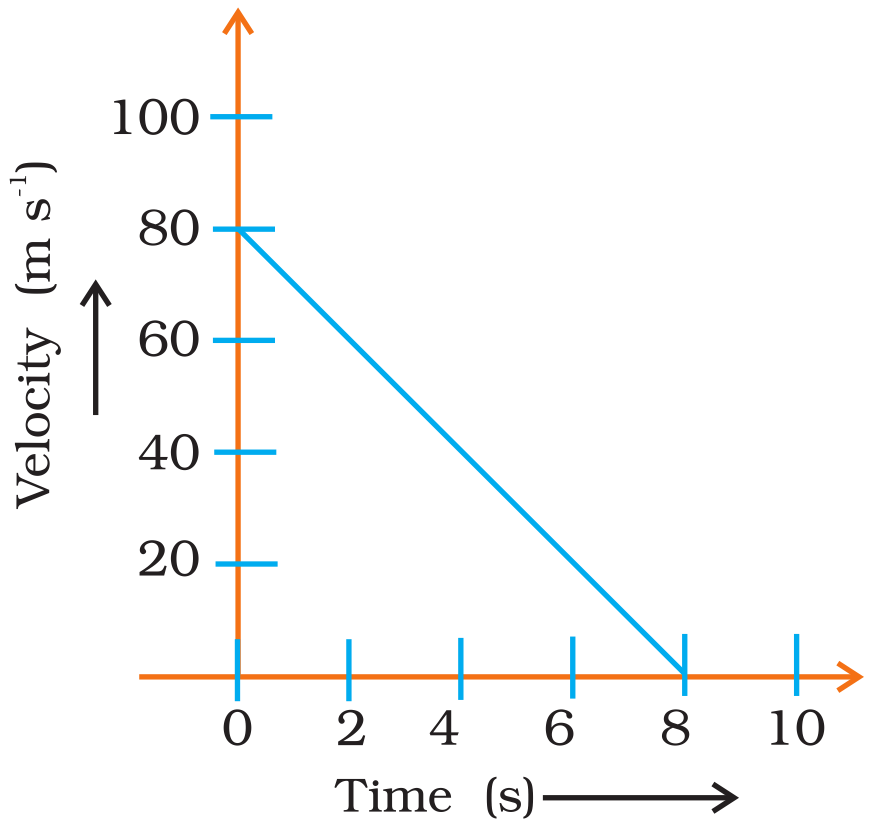
Velocity versus time graph of a ball of mass $50g$ rolling on a concrete floor is shown in Fig. Calculate the acceleration and frictional force of the floor on the ball.
Which has more atoms, $50g $ of aluminium or $50g$ of iron$?$ Illustrate your answer with the help of calculations.
$($Atomic masses: $Al = 27u; Fe = 56u)$
i. Under which category of mixtures will you classify alloys and why?
ii. Whether a solution is always liquid or not. Comment.
iii. Can a solution be heterogeneous?
Explain general characteristics of phylum Platyhelminthes and Nematoda. Give two examples of each.
Show by using the graphical method that:$\text{s}=\text{ut}+\frac{1}{2}\text{at}^2$
where the symbols have their usual meanings.
Show by using the graphical method that:
$\text{s}=\text{ut}+\frac{1}{2}\text{at}^2$
where the symbols have their usual meanings.