Question
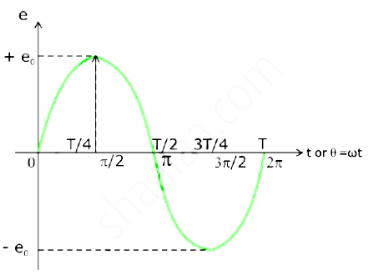
Obtain an expression for e.m.f. induced in a coil rotating with uniform angular velocity in a uniform magnetic field. Show graphically the variation of e.m.f. with time (t).
Answer

Coil rotating in uniform magnetic field:
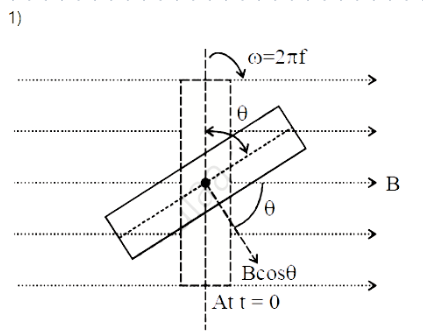
Consider a coil of ‘N’ turns with effective area NA placed in uniform magnetic induction B as shown in the figure below.
Image
The coil is rotated continuously with constant angular velocity ω. The axis of rotation is in the plane of the coil and normal to the magnetic induction B.
At t = 0, the plane of the coil is perpendicular to the magnetic induction B.
The magnetic flux passing through the coil is NAB.
After t seconds, the plane of the coil is at an angle θ.
Thus, the magnetic flux Φ through the coil at time t is given by
Φ = NABcosθ = NABcosωt
As time changes, the magnetic flux goes on changing. Hence, the e.m.f. generated in the coil is given by
\(e=-\frac{d \phi}{d t}=-\frac{d}{d t}(N A B \cos \omega t)\)
e = NABωsinωt
e = 2πfNABsinωt
This is the expression for induced e.m.f. generated in the coil at any instant t. It is known as instantaneous e.m.f.
Image
Given that
$R/L = \sigma = 0.1Ω/cm = 0.1 x 100 = 10Ω/m$
$l_1 = 300 cm = 3 m, E_1 = 1.5 V, E_2= 1.4 V$
We know that
$E_1 = iR_1 =i\sigma l_1$
\(\therefore i=\frac{E_1}{\sigma l_1}=\frac{1.5}{10 \times 3}=0.05 A\)
Hence, the current for the other cell is 0.05 A.
For potentiometer, the balancing condition is
\(\frac{E_1}{E_2}=\frac{l_1}{l_2}\)
\(\therefore l_2=l_1 \frac{E_2}{E_1}=3 \times \frac{1.4}{1.5}=2.8 m\)
So, the balancing length for the other cell is 2.8 m.

Need a full question paper?

Generate a complete, print-ready paper with questions like this in minutes — across 16+ boards, with answer keys.

Start Generating Free

Similar questions

The primary of a transformer has $40$ turns and works on $100 V$ and $100 W$. Find the number of turns in the secondary to step up the voltage to $400 V$. Also calculate the current in the secondary and primary.
Explain the phenomenon of polarization of light by reflection.
Calculate the energy released in the following reactions, given the masses to be ${ }_{88}^{223} Ra$ : $223.0185 u _8^{209} Pb : 208.9811,{ }_6^{14} C : 14.00324,{ }_{92}^{236} U : 236.0456,{ }_{56}^{140} Ba : 139.9106,{ }_{36}^{94} Kr$ : 93.9341, ${ }_6^{11} C : 11.01143,{ }_5^{11} B : 11.0093$. Ignore neutrino energy.
(a) ${ }_{88}^{223} Ra \rightarrow{ }_{82}^{209} Pb +{ }_6^{14} C$
(b) ${ }_{92}^{836} U \rightarrow{ }_{56}^{140} Ba +{ }_{36}^{94} Kr +2 n$
(c) ${ }_6^{11} C \rightarrow{ }_5^{11} B + e ^{+}+$neutrino
Explain how a moving-coil galvanometer is converted into a voltmeter. Derive the necessary formula.
State the postulates of Newton's corpuscular theory of light.
Explain thermodynamics of the adiabatic process.
Using the energy conservation, derive the expression for minimum speeds at different locations along a al circular motion controlled by gravity.
Derive an expression for the energy stored in the magnetic field of an inductor.###Derive an expression for the electrical work done in establishing a steady current in a coil of self inductance L.
Obtain an expression for the electric field intensity at a point outside a charged conducting spherical shell.
Hence, obtain an expression for the electric intensity (i) on the surface of (i.e., just outside) the spherical conductor (ii) inside the spherical conductor.
Observations from an experiment on photoelectric effect for the stopping potential by varying the incident frequency were plotted. The slope of the linear curve was found to be approximately $4.1 \times 10^{-15} V s$. Given that the charge of an electron is $1.6 \times 10^{-19} C$, find the value of the Planck's constant $h$.