Maharashtra BoardEnglish MediumSTD 12 SciencePhysicsQuestion Bank [ 2022 ]3 Marks
Question
Obtain an expression for the angular momentum of a body rotating with uniform angular velocity.
✓
Answer
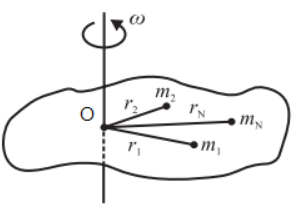
i. Consider a rigid object rotating with a constant angular speed ' $\omega$ ' about an axis perpendicular to the plane of the paper.
A body of $N$ particles
ii. Let us consider the object to be consisting of $N$ number of particles of masses $m_1, m_2, \ldots . . m_N$ at respective perpendicular distances $r_1, r_2, \ldots . . r_N$ from the axis of rotation.
iii. As the object rotates, all these particles perform UCM with the same angular speed $\omega$, but with different linear speeds $v_1=r_1 \omega$, $v_2=r_2 \omega, \ldots . . v_N=r_N \omega$.
Directions of individual velocities $\overrightarrow{ v }_1, \overrightarrow{ v }_2, \ldots \ldots \overrightarrow{ v }_{ N }$, are along the tangents to the irrespective tracks.
iv. Linear momentum of the first particle is of magnitude $p_1=m_1 v_1$ $=m_1 r_1 \omega$. Its direction is along that of $\vec{v}_1$.
Its angular momentum is thus of magnitude $L_1=p_1 r_1=m_1 r_1^2 \omega$ Similarly, $L _2= m _1 r _2^2 \omega, L _3= m _3 r _3^2 \omega, \ldots, L _{ N }= m _{ N } r _{ N }^2 \omega$.
$v$. For a rigid body with a fixed axis of rotation, all these angular momenta are directed along the axis of rotation, and this direction can be obtained by using the right-hand thumb rule. As all of them have the same direction, their magnitudes can be algebraically added.
vi. Thus, the magnitude of angular momentum of the body is given by
$ L = m _1 r _1^2 \omega+ m _1 r _2^2 \omega+\ldots .+ m _{ N } r _{ N }^2 \omega$
$=\left( m _1 r _1^2+ m _2 r _2^2+\ldots \ldots+ m _{ N } r _{ N }^2\right) \omega= I \omega $
where, $l = m _1 r _1^2+ m _2 r _2^2+\ldots .+ m _{ N } r _{ N }^2$ is the moment of inertia of the body about the given axis of rotation.
Need a full question paper?
Generate a complete, print-ready paper with questions like this in minutes — across 16+ boards, with answer keys.