Maharashtra BoardEnglish MediumSTD 12 SciencePhysicsQuestion Bank [ 2022 ]3 Marks
Question
Obtain an expression for the capacitance of a parallel plate capacitor without a dielectric.
✓
Answer
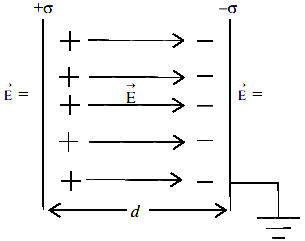
i. A parallel plate capacitor consists of two thin conducting plates each of area A, held parallel to each other, at a suitable distance $d$ apart. ii. The plates are separated by an insulating medium like paper, air, mica, glass, etc. One of the plates is insulated and the other is earthed as shown in the figure below. iii. When a charge $+Q$ is given to the insulated plate, then a charge $-Q$ is induced on the inner face of the earthed plate and $+Q$ is induced on its farther face. But as this face is earthed the charge $+Q$ being free, flows to earth. iv. In the outer regions, the electric fields due to the two charged plates cancel out. Making net field is zero. $ E =\frac{\sigma}{2 \varepsilon_0}-\frac{\sigma}{2 \varepsilon_0}=0 $ $v$. In the inner regions between the two capacitor plates, the electric fields due to the two charged plates add up. The net field is thus $ E =\frac{\sigma}{2 \varepsilon_0}+\frac{\sigma}{2 \varepsilon_0}=\frac{\sigma}{\varepsilon_0}=\frac{ Q }{ A \varepsilon_0} \ldots . . \text { (1) } $ The direction of $E$ is from positive to negative plate. vi. Let $V$ be the potential difference between the two plates. Then electric field between the plates is given by $E=\frac{V}{d}$ or $V= Ed$....(2) Substituting equation (1) in equation (2), $ V=\frac{Q}{A \varepsilon_0} d $ vii. Thus, the capacitance of the parallel plate capacitor is given by, $ C =\frac{ Q }{ V }=\frac{ Q }{\left(\frac{ Qd }{ A \varepsilon_0}\right)}=\frac{ A \varepsilon_0}{ d } $ This is the required expression.
Need a full question paper?
Generate a complete, print-ready paper with questions like this in minutes — across 16+ boards, with answer keys.