Question
Obtain an expression for torque acting on a body rotating with uniform angular acceleration.

Answer

Expression for torque acting on a rotating body
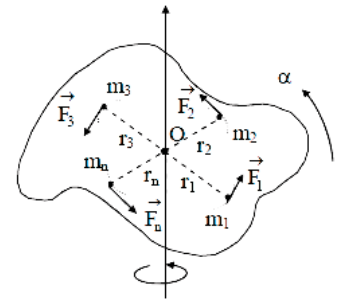
Image
a) Suppose a rigid body consists of n particles of masses $m_1, m_2, m_3,$ ......, mn which are situated at distances $r_1, r_2, r_3,$ …, rn respectively, from the axis of rotation as shown in figure
b) Each particle revolves with angular acceleration α
c) Let$ F_1, F_2, F_3,$ …., Fn be the tangential force acting on particles of masses, $m_1, m_2, m_3,$ …, mn respectively.
d) Linear acceleration of particles of masses $m_1, m_2,$…, mn are given by, $a_1 = r_1\alpha , a_2 = r_2\alpha , a_3 = r_3\alpha = rn\alpha$
e) Magnitude of force acting on particle of mass m1 is given by $F_1 = m_1a_1 = m_1r_1\alpha ( a = r\alpha )$
Magnitude of torque on particle of mass m1 is given by,
$t_1 = F_1 r_1 sin Θ$                         ($\because$ Radius vector is $\perp ^{ar}​​​​​​​$​​​​​​​ to tangential force)
\(\therefore \quad \tau_1= F _1 r _1 \sin 90^{\circ}\)
\(= F _1 r _1\)
\(=m_1 a_1 r_1\)
\(\therefore \quad \tau_1= m _1 r _1^2 \alpha \quad\left(\because a _1= r _1 \alpha\right)\)
Similarly,
\(\tau_2=m_2 r_2^2 \alpha\)
\(\tau_3= m _3 r _3^2 \alpha\),
\(\tau_n=m_n r_n^2 \alpha\)
f. Total torque acting on the body,
\(\tau=\tau_1+\tau_2+\tau_3+\ldots .+\tau_n\)
\(\therefore \quad \tau=m_1 r_1^2 \alpha+m_2 r_2^2 \alpha+m_3 r_3^2 \alpha+\ldots+m_n r_n^2 \alpha\)
\(\therefore \quad \tau=\left(m_1 r_1{ }^2+m_2 r_2{ }^2+m_3 r_3^2+\ldots .+m_n r_n^2\right) \alpha\)
\(\therefore \quad \tau=\left(\sum_{ i =1}^{ n } m _{ i } r _{ i }^2\right) \alpha\)
But, \(\sum_{ i =1}^{ n } m _{ i } r _{ i }{ }^2= I\)
\(\therefore \quad \tau= I \alpha\)
g. If \(\alpha=1 rad / s ^2\) then \(\tau= I\).
Thus, when a torque rotates the body with uniform angular acceleration of $1 rad/s^2$​​​​​​​ then M.I of the body about a given axis of rotation becomes equal to torque acting on it.

Need a full question paper?

Generate a complete, print-ready paper with questions like this in minutes — across 16+ boards, with answer keys.
Start Generating Free

Similar questions

A spherical liquid drop of diameter $2 \times 10^{-4} \mathrm{~m}$ is falling with a constant velocity through air, under gravity. If the density of the liquid is $500 \mathrm{~kg} / \mathrm{m} 3$ and the coefficient of viscosity of air is $2 \times 10^{-5} \mathrm{~Pa} . \mathrm{s}$, determine the terminal velocity of the drop and the viscous force acting on it. Ignore the density of air.
A Carnot engine receives $6 \times 10^4 J$ from a reservoir at $600 K$, does some work, and rejects some heat to a reservoir at $500 K$. Find the
(i) the heat rejected by the engine
(ii) the work done by the engine
(iii) the efficiency of the engine.
Obtain an expression for the angular momentum of a body rotating with uniform angular velocity.
An open tube manometer is connected to (i) a vacuum-packed candy jar, with the atmospheric pressure in the open tube supporting a column of fluid of height h (ii) a gas tank, with the absolute pressure in the tank supporting a column of fluid of height h. Is the absolute pressure in the jar and the gas tank greater than or less than the atmospheric pressure ? By how much ?
In a meter bridge, the balance point is found to be at 39.5 cm from the end A when the resistor R is 12.5 Ω (right gap).
a) Determine the resistance of X (left gap).
b) Determine the balance point of the bridge if X and R are interchanged?
c) What happens if the galvanometer and cell are interchanged at the balance point of the bridge?
Radiant energy is incident on a body at the rate of 2000 joules per minute. If the reflection coefficient of the body is 0.1 and its transmission coefficient is 0.2 , find the radiant energy
(i) absorbed
(ii) reflected
(iii) transmitted by the body in 2 minutes.
State any two characteristics of angle of contact.
Draw a neat circuit diagram to study the characteristics of common emitter n-p-n transistor. With the help of a graph, explain the output characteristics of this transistor.
Write the kinematical equations for circular motion in analogy with linear motion.
A perfect blackbody, maintained at $27^{\circ} \mathrm{C}$, radiates energy at the rate of $551.1 \mathrm{~W}$. Find the surface area of the body.