MCQ
Obtain the dimensional equation for universal gas constant.
  • $[\text{ML}^2\text{T}^{-2}]\text{ mol }^{-1}\text{K}^{-1}$
  • B
    $[\text{M}^2\text{LT}^{-1}\text{mol }^{-2}\text{K}^{-2}]$
  • C
    $[\text{ML}^{2}\text{L}\text{T}^{-1}\text{ mol}^{-1}\text{K}^{-1}]$
  • D
    $[\text{ML}^{3}\text{L}\text{T}^{-1}\text{ mol}^{-1}\text{K}^{-2}]$
Answer

Correct option: A.
$[\text{ML}^2\text{T}^{-2}]\text{ mol }^{-1}\text{K}^{-1}$
According to ideal gas equation for universal gas constant.
i.e., $\text{pV = nR}T,$ where $n$ is the number of moles of gases.
$\text{R}=\frac{(\text{p})(\text{V})}{(\text{n})(\text{T})}=\frac{[\text{ML}^{-1}\text{T}^2][\text{L}^3]}{{[\text{mol}][\text{K}]}}$
$=[\text{ML}^2\text{T}^{-2}\text{mol}^{-1}\text{K}^{-1}]$

Need a full question paper?

Generate a complete, print-ready paper with questions like this in minutes — across 16+ boards, with answer keys.

Start Generating Free

Similar questions

The change in the value of acceleration of earth towards sun, when the moon comes from the position of solar eclipse to the position on the other side of earth in line with sun is: (mass of the moon $= 7.36 \times 10^{22}\,kg,$ radius of the moon's orbit $= 3 .8 \times 10^8\,m$ ).
A cylindrical wire of radius $1\,\, mm$, length $1 m$, Young’s modulus $= 2 × 10^{11} N/m^2$, poisson’s ratio $\mu = \pi /10$ is stretched by a force of $100 N$. Its radius will become
An ideal heat engine exhausting heat at $27^\circ C$ is to have $25\%$ efficiency. It must take heat at:
A mass $'m'$ moves with a velocity $'v'$ and collides inelastically with another identical mass in rest. After collision the $I^{st}$ mass moves with velocity $\frac{v}{{\sqrt 3 }}$ in a direction perpendicular to the initial direction of motion. Find the speed of the $2^{nd}$ mass after collision
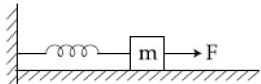
A block of mass $m$, lying on a smooth horizontal surface, is attached to a spring (of negligible mass) of spring constant $k$. The other end of the spring is fixed, as shown in the figure. The block is initially at rest in a equilibrium position. If now the block is pulled with a constant force $F$, the maximum speed of the block is
Consider two rods of same length and different specific heats $\left( c _1, c _2\right)$, thermal conductivities $\left( K _1, K_2\right)$ and area of cross-sections $\left(A_1, A_2\right)$ and both having temperatures $\left(T_1, T_2\right)$ at their ends. If their rate of loss of heat due to conduction is equal, then:
$5\, g$ of ice at $0°C$ is dropped in a beaker containing $20\, g$ of water at $40°C.$ The final temperature will be........ $^oC$
$A$ block of mass $m$ moving with a velocity $v_0$ on a smooth horizontal surface strikes and compresses a spring of stiffness $k$ till mass comes to rest as shown in the figure. This phenomenon is observed by two observers:

$A$: standing on the horizontal surface

$B$: standing on the block 

To an observer $A,$ the net work done on the block is

A cricket ball of mass $150g$ moving with a speed of $126\ km/ h$ hits at the middle of the bat, held firmly at its position by the batsman. The ball moves straight back to the bowler after hitting the bat. Assuming that collision between ball and bat is completely elastic and the two remain in contact for $0.001s$, the force that the batsman had to apply to hold the bat firmly at its place would be:
Instantaneous temperature difference between cooling body and the surroundings obeying Newton's law of cooling is $\theta$. Which of the following represents the variation of $\ln \theta$ with time $t$ ?